7 Proven Ways to Find Vetted Home Contractors in Dallas
Find vetted home contractors in Dallas using our AI-driven analysis and 7-step vetting process for your home renovation.
7 Proven Ways to Find Vetted Home Contractors in Dallas
Why Finding Vetted Home Contractors in Dallas Is Harder Than It Should Be
Finding vetted home contractors in Dallas can feel like a gamble — and for too many homeowners, it is. More than half of all homeowners report a negative experience with a contractor or remodeling project. That is not a small number. That is the majority.
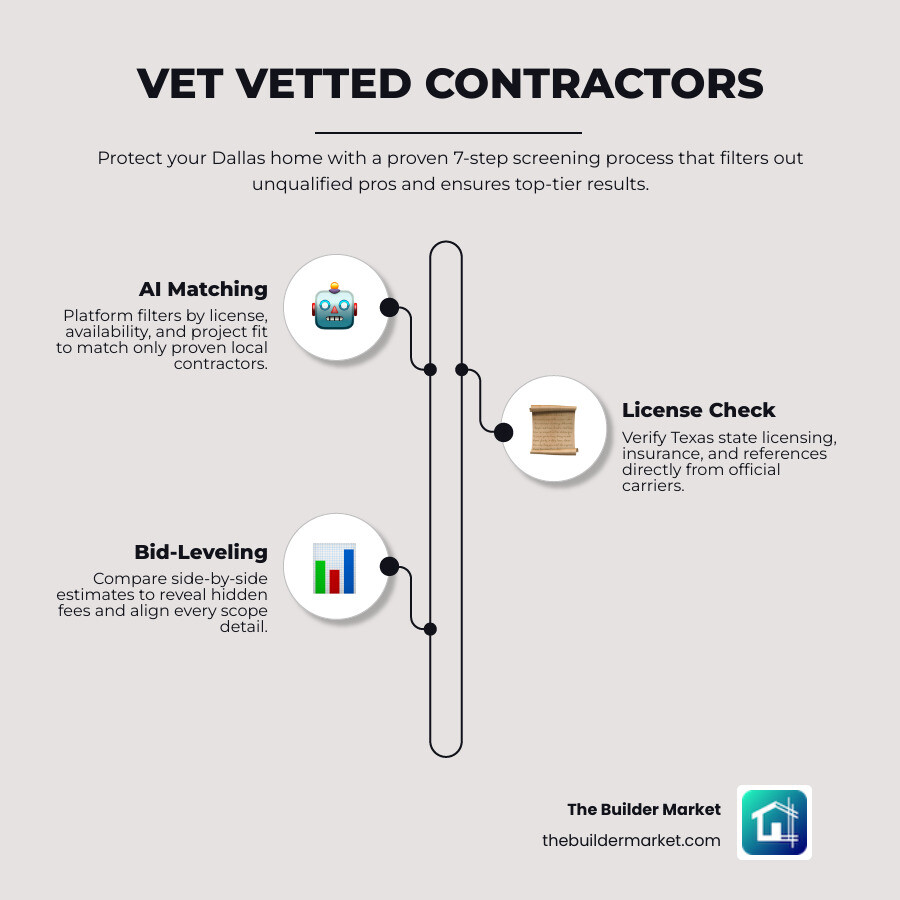
Here are the 7 proven ways to find vetted home contractors in Dallas:
- Use an AI-powered matching platform to filter pros by license, availability, and project fit
- Verify local licensing through Texas state licensing databases before any work begins
- Confirm insurance coverage by calling the carrier directly — not just accepting a certificate
- Gather 3 to 5 competing bids based on the exact same project scope
- Use bid-leveling to compare estimates side by side and spot hidden fees
- Check references and recent work from local Dallas projects specifically
- Require a written contract that includes milestones, lien releases, and a dispute resolution process
The Dallas home improvement market is busy and competitive. That makes it easier for underqualified or unvetted contractors to slip through the cracks. Some disappear mid-project. Others cut corners that only show up months later.
The difference between a smooth renovation and a nightmare often comes down to one thing: whether the contractor was properly vetted before work ever started.
This guide breaks down exactly what vetting means, what to look for, and how to protect yourself financially and legally — so your next Dallas project goes the way it should.
Why You Should Only Hire Vetted Home Contractors in Dallas
Hiring a contractor shouldn't feel like a trip to the casino. When we talk about vetted home contractors, we are referring to professionals who have undergone a rigorous, multi-layered screening process that goes far beyond a simple star rating on a public review site. In May 2026, the standard for a "trusted" professional has evolved. It now involves a 10-point screening process that includes background checks, identity verification, and a deep dive into business ethics.
Standard online reviews are often skewed. A contractor might have five stars because they are friendly, but that doesn't mean they carry the right insurance or follow local Dallas building codes. Vetting platforms filter out the noise, often approving fewer than 5% of the contractors who apply to be on their "trusted" lists. This ensures you are working with the elite of the industry.
| Feature | Vetted Professionals | Standard Online Reviews |
|---|---|---|
| Identity Verification | Confirmed via government ID | Not required |
| License Check | Verified with state/local boards | Self-reported |
| Insurance | Verified active with carrier | Often outdated or missing |
| Background Checks | Criminal and civil litigation scans | None |
| Accountability | Third-party mediation & guarantees | None (User beware) |
How AI-Driven Analysis Identifies Vetted Home Contractors
In our modern era, we use AI-driven analysis to protect homeowners from poor workmanship. This technology allows us to perform a skill assessment by analyzing past project data, completion rates, and client satisfaction metrics at scale. While a human might miss a pattern of delays or minor code violations, AI identifies these trends instantly.
This data-driven approach is why platforms using these tools report a 98% client satisfaction rate. By evaluating professionalism standards—such as how quickly a contractor responds to inquiries or how accurately they price their initial bids—AI ensures that only the most reliable pros make the cut. It’s about moving from "I hope they're good" to "I know they're qualified."
The Role of a Remodeling Advisor for Vetted Home Contractors
For many of us, a major home renovation is the largest investment we will ever make. Navigating this "arcane" world alone is daunting. That is where a dedicated remodeling advisor or concierge service comes in. Think of them as your project’s executive advocate.
An advisor provides project oversight from start to finish. They help you interpret complex bids, ensure milestones are being met, and act as a "voice of truth" if communication with the contractor becomes strained. This layer of homeowner protection ensures that you aren't just handed a list of names and left to fend for yourself; you have expert guidance every step of the way.
Verifying Local Licensing and Insurance Credentials
Before a single hammer swings in your Dallas home, you must verify the contractor's credentials. This isn't just about red tape; it's about asset protection. In Texas, while the state doesn't license general contractors at the state level, many specialty trades (like plumbing, electrical, and HVAC) require specific state licenses. Furthermore, Dallas has its own registration requirements that contractors must follow.
Checking a contractor’s employee tenure and community reputation also tells a story. A company with a rotating door of workers is a red flag. You want a team with a high "retention rate," which usually signals a stable, well-managed business. If you are looking for specific remodeling help, you can find more information about remodeling services in Dallas to see what local standards look like.
Verifying Worker’s Compensation and Liability
Never take a "Certificate of Insurance" at face value. We recommend calling the insurance carrier directly to confirm that the policy is active and covers the specific type of work being done. There are two critical types of coverage:
- General Liability: Protects your home from property damage (e.g., a pipe bursts and floods your flooring).
- Worker’s Compensation: Protects you if a worker is injured on your property. Without this, you could be held personally liable for their medical bills.
Rigorous risk management means ensuring the contractor is bonded and insured to the full value of your project.
The Impact of Local Ownership and Tenure
There is a unique reliability that comes with local ownership. A contractor who has spent twenty years building a reputation in Dallas is less likely to abandon a project than a "storm chaser" from out of state. These local pros have a vested interest in community trust. They rely on word-of-mouth and their standing with local building inspectors. When you hire someone with deep roots in the community, you are hiring someone who is accountable to their neighbors, not just a corporate office in another time zone.
Using Bid-Leveling to Avoid Hidden Renovation Fees

One of the biggest mistakes homeowners make is choosing the lowest bid without understanding why it’s the lowest. To avoid hidden fees and "change order" nightmares, we use a process called bid-leveling. This is the technical act of normalizing competing estimates to ensure you are comparing apples to apples.
Normalizing Competing Estimates
If Contractor A quotes a price for "kitchen cabinets" and Contractor B quotes a price for "custom maple cabinets with soft-close hinges," those are not the same bid. Bid-leveling involves a side-by-side analysis of:
- Material Specifications: Are they using high-end materials or builder-grade?
- Labor Breakdown: Is the demo included? What about debris removal?
- Permit Fees: Who is responsible for filing and paying for city permits?
By breaking these down, you can make an informed decision based on value, not just the bottom-line number.
Identifying Red Flags in the Bidding Process
During your initial consultation, pay attention to how the contractor communicates. A "trustworthy contractor" treats the process like a business consultation. Watch out for these red flags:
- Vague Estimates: If the bid is a single page with a lump sum and no details, run.
- Pressure Tactics: "This price is only good if you sign today."
- Communication Gaps: If they take a week to return a text before you've even hired them, it won't get better once they have your deposit.
- Unrealistic Low Bids: A bid that is significantly lower than others usually means they’ve missed a part of the scope or plan to cut corners on labor and materials.
Financial Protections and Project Accountability
Even with the best vetted home contractors, disputes can happen. The difference is how those disputes are handled. When you use a trusted network, you gain access to a financial safety net. Some top-tier vetting platforms offer a $25,000 guarantee. This means if a contractor abandons your project or fails to meet the written standards of the contract, the platform takes financial responsibility to "make it right."
Essential Items for a Transparent Written Contract
Your contract is your primary tool for risk mitigation. Never allow work to start on a "handshake deal." A transparent written contract must include:
- Detailed Scope of Work: Every material, every fixture, and every task.
- Milestone Payments: Never pay 100% upfront. Tie payments to specific, inspected stages of the project.
- Lien Releases: Ensure you receive signed releases from subcontractors and material suppliers so they can't place a lien on your home if the general contractor fails to pay them.
- Dispute Resolution: A clear path for mediation if things go wrong.
How Vetting Platforms Maintain Contractor Accountability
Accountability shouldn't end when the contract is signed. Vetting platforms maintain high standards by continuously monitoring contractor performance. If a pro's satisfaction rating drops or they fail to resolve a valid client complaint, they are removed from the network. This ongoing integrity screening creates a powerful incentive for contractors to maintain professionalism throughout the entire duration of your project.
Conclusion
At The Builder Market, we believe that hiring a contractor shouldn't be the most stressful part of your year. As the first AI-powered platform designed for real homeowners and real projects, we have built a national network of over two million verified professionals. Our goal is to bring transparency to an industry that has been "arcane" for too long. By combining intelligent matching with a focus on quality connections, we help you skip the guesswork.
Whether you are planning a small repair or a major addition, our tools are designed to give you the confidence that your home — and your investment — is in good hands. Find vetted home contractors in Dallas today and start your project with the peace of mind you deserve.
Frequently Asked Questions
What defines a vetted contractor? A vetted contractor is a professional who has passed a multi-point screening process. This includes verifying their identity, checking for active local and state licenses, confirming insurance coverage (liability and worker’s comp), and performing background checks for criminal history or civil litigation. Unlike public review sites, vetting is a proactive verification of a contractor's legal and ethical standing.
How does the $25,000 guarantee protect my project? The $25,000 guarantee acts as a financial safety net. If a contractor from a vetted list fails to complete the work as specified in your contract or abandons the project, the guarantee can cover up to $25,000 to hire a new professional to finish the job or repair poor workmanship. It is designed to ensure the homeowner isn't left "holding the bag" for a professional's failure.
Why is bid-leveling important for my renovation? Bid-leveling is essential because it allows you to compare different quotes on an equal basis. Contractors often use different terminology or exclude certain costs (like permits or materials). Bid-leveling breaks these down into line items, ensuring you understand exactly what you are paying for and helping you identify "too good to be true" low bids that might hide future fees.
Need Help?
Contact us today to discuss your needs. Our team is ready to help.
About the Author
The Builder Market
More Articles
View All PostsRelated Articles
Ready to grow with The Builder Market?
Explore listings, AI growth, sites, and lead options—or talk to our team about what fits your business.

