Best Home Improvement Loans 2026: Compare Top Options
Compare best home improvement loans 2026 by credit, speed, and project size to find the right financing for your renovation.
Best Home Improvement Loans 2026: Compare Top Options
Looking for Trusted Home Improvement Financing Help and Local Pros in 2026?
The best home improvement loans in 2026 can help homeowners move forward with repairs, remodeling, and upgrades more confidently. As more people choose to improve their current home instead of moving, understanding financing options has become an important part of project planning.
Whether you're dealing with an urgent roof issue, planning a kitchen remodel, or adding a bathroom, the right financing option depends on your credit profile, project size, timeline, and whether you want to use home equity.
Here is a simple overview of common home improvement financing options in 2026:
| Borrower Need | Best Loan Type | Typical Financing Range | Funding Speed |
|---|---|---|---|
| Good to excellent credit | Personal loan | Lower to moderate APR range | 1-2 business days |
| Fair credit | Personal loan | Moderate to higher APR range | 1-3 business days |
| Large renovation budget | High-limit personal loan | Higher borrowing limits available | 3-5 business days |
| Urgent / emergency repairs | Fast-funding personal loan | Varies by lender | Same day - 24 hours |
| Small projects | 0% APR credit card or small personal loan | Intro offers or standard loan terms | Immediate (card) |
| Limited or no home equity | Unsecured personal loan | Broad qualification range | 1-3 business days |
| Large phased remodel with equity | HELOC | Often lower than unsecured loans | 2-4 weeks |
The sections below explain how these options work, what borrowers should look for, and how personal loans compare with home equity products, HELOCs, and government-backed programs.
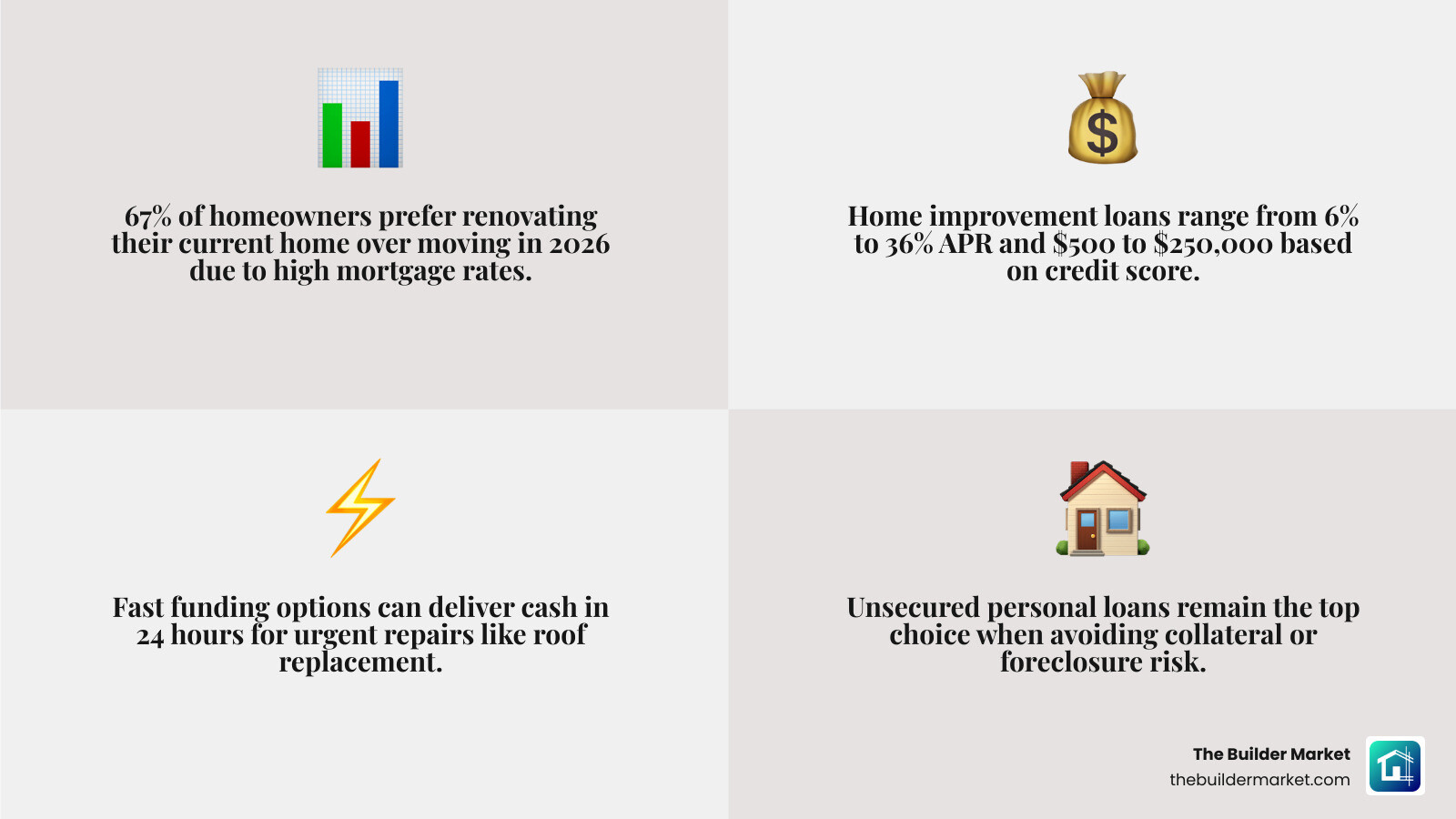
Best Home Improvement Loans 2026: What Fits Your Project?
When most homeowners search for the best home improvement loans 2026, they are usually asking a simpler question: "What financing option makes sense for my project?"
A "home improvement loan" is often a personal loan used for repairs, remodels, or upgrades. Some are unsecured, meaning no collateral is required. Others are secured, which may help borrowers access larger limits.
Here is a practical comparison by borrower need:
| Borrower profile | Best fit | Why it stands out | Watch for |
|---|---|---|---|
| Good to excellent credit | Unsecured personal loan | Fixed payments, simple application, no home collateral | Best terms usually go to stronger borrowers |
| Fair credit | Flexible personal loan | Easier qualification and softer underwriting | Higher APRs and possible origination fees |
| Large renovation budget | High-limit loan or equity-based option | Bigger borrowing power and longer terms | More documentation or collateral risk |
| Urgent repair | Fast-funding personal loan | Speed, fixed payments, simple application | Rates may be higher than equity products |
| Small project | Small personal loan or 0% intro card | Convenient for lighter updates | Promo cards need fast payoff discipline |
Best home improvement loans 2026 for good to excellent credit
If your credit is strong, unsecured personal loans are often one of the simplest options. They usually offer:
- Fixed rates
- Fixed monthly payments
- No home collateral
- Fast funding
- Potential autopay discounts
Strong credit can improve your chances of qualifying for better loan terms.
This option is often a good fit for:
- Kitchen or bathroom remodels
- Window replacement
- HVAC replacement
- Mid-sized exterior upgrades
- Combining multiple repair invoices into one payment
Best home improvement loans 2026 for fair credit
Fair-credit borrowers can still qualify, but comparing lenders carefully matters.
For fair credit, focus on:
- Lenders that allow soft-pull prequalification
- Lower minimum credit score thresholds
- Reasonable loan sizes
- Fee transparency
- Options for co-borrowers or secured loans
If your score is not ideal, borrowing only what you need and choosing a manageable repayment term can help keep the loan more practical.
Best option for large renovation budgets
For major remodels, additions, or whole-home work, loan size matters as much as flexibility.
This category fits projects like:
- Large-scale additions
- Multi-room renovations
- Structural repairs
- Full kitchen-and-bath overhauls
Longer terms can help monthly cash flow, but they may also increase total interest over time.
Best option for fast funding and urgent repairs
When the roof is leaking or plumbing fails, speed matters. Personal loans often stand out for faster access to funds.
They can be a strong fit for:
- Emergency roof repair
- Burst pipe or water damage response
- Electrical hazards
- Heating or cooling replacement before severe weather
- Critical accessibility improvements
Best option for smaller projects
Not every home upgrade needs a large loan. For smaller jobs, convenience and repayment discipline matter most.
Good fits include:
- Small unsecured personal loans
- Credit union loans
- 0% intro APR credit cards, if you can pay them off before the promotional period ends
These work well for:
- Appliance replacement
- Minor bathroom refreshes
- Flooring in one room
- Small deck or patio work
- Basic cosmetic updates
How Home Improvement Loans Work

What is a home improvement loan and how does it work?
A home improvement loan is usually a personal installment loan used to pay for renovations, repairs, or upgrades. You receive the funds as a lump sum, then repay the balance in equal monthly installments over a set term.
Most are unsecured, which means:
- No home equity is required
- Your house is not collateral
- Approval depends mainly on credit, income, debt, and overall financial profile
The process usually looks like this:
- Estimate your project scope.
- Prequalify with several lenders using a soft credit check.
- Compare APR, fees, term length, and monthly payment.
- Submit a full application.
- Accept the offer and receive funds.
- Pay your contractor and repay the loan monthly.
Typical APRs, loan amounts, and repayment terms in 2026
In 2026, home improvement personal loans generally fall into these ranges:
- APRs: about 6% to 36%
- Loan amounts: available from smaller project financing to larger renovation borrowing, depending on the lender
- Repayment terms: commonly 2 to 7 years, though some home-improvement loans extend longer
These ranges can vary significantly based on credit profile, income, and lender requirements. That is why the best loan is usually the best real offer you qualify for, not just the lowest advertised rate.
How quickly can borrowers receive funding?
Funding speed is one of the biggest reasons homeowners choose personal loans over equity-based borrowing.
Typical timelines:
- Fastest online lenders: same day or next day for qualified borrowers
- Most online lenders: 1 to 3 business days
- Banks and credit unions: often a few days longer
- Home equity loans and HELOCs: commonly 2 to 4 weeks due to appraisal and closing steps
If you are fixing storm damage or an urgent system failure, faster funding can be especially helpful.
Fees borrowers should watch for
APR tells more of the story than the interest rate alone because it can include certain fees. Before signing, check for:
- Origination fees
- Late fees
- Returned payment or insufficient funds fees
- Prepayment penalties
- Administrative charges
A common issue is focusing on the approved amount without confirming the amount actually disbursed after fees. Always review the final loan details carefully.
Pros, Cons, and When a Loan Makes Sense
Pros and cons of using a home improvement loan
Home improvement loans can be useful, but they are not magic. Sadly, they do not also install the backsplash.
Pros:
- Fast funding
- Fixed monthly payments
- No home equity required
- No collateral risk for unsecured loans
- Flexible use for many project types
- Predictable payoff timeline
Cons:
- APRs can be high, especially for fair or bad credit
- Monthly payments can strain your budget
- Personal loan interest is generally not tax-deductible
- Shorter terms can mean higher monthly payments
- Fees may increase total cost
When it’s better to use cash or other financing instead of a loan
A loan is not always the smartest move. Cash may be better if:
- The project is small
- You can pay without draining emergency savings
- The upgrade is mostly cosmetic
- You expect to pay it off quickly anyway
Other financing may be better when:
- A 0% intro APR card fits a small project and you can repay in time
- A HELOC suits a phased remodel
- A home equity loan offers lower rates for a large one-time project
- An FHA program fits a purchase-plus-renovation or qualifying repair scenario
A good rule of thumb: do not stretch long-term debt for short-lived trends. Your future self may not want to be paying for a very 2026 tile choice in 2033.
When borrowing can be reasonable for essential repairs
Borrowing often makes more sense for necessary work than for purely cosmetic wants. Essential projects can include:
- Roof replacement
- Plumbing failures
- Electrical hazards
- Accessibility modifications
- Weather-related repairs
- Safety issues that cannot wait
If you are coordinating repair work and still vetting local professionals, you can review more information about plumbing and repair-related services.
Home Improvement Loans vs Home Equity Loans, HELOCs, and Other Financing
Personal loan vs home equity loan
A personal loan is usually unsecured. A home equity loan is secured by your home.
Personal loan strengths:
- Faster approval
- No appraisal in most cases
- No closing process like a mortgage product
- No foreclosure risk tied directly to the loan collateral
Home equity loan strengths:
- Often lower rates
- Fixed monthly payments
- Better for larger project amounts
- Interest may be tax-deductible when used for qualified home improvements, subject to tax rules
Choose a personal loan when speed and simplicity matter. Choose a home equity loan when the project is large, your equity is strong, and you are comfortable using the home as collateral.
Personal loan vs HELOC
A HELOC is a revolving line of credit secured by your home. Instead of receiving one lump sum, you draw funds as needed during a draw period.
Personal loan is usually better for:
- One-time projects with clear budgets
- Faster funding needs
- Homeowners who do not want collateral risk
HELOC is usually better for:
- Multi-phase remodels
- Uncertain or evolving project budgets
- Borrowers wanting to pay interest only on what they draw initially
The trade-off is that HELOCs often have variable rates, and your payment can change over time.
Cash-out refinance, credit cards, FHA programs, and contractor financing
Other options can make sense in the right situation:
- Cash-out refinance: useful when mortgage rates and equity position make it worthwhile, but it resets your mortgage terms
- 0% intro APR credit cards: best for smaller projects you can repay within the promo period
- FHA Title 1 loans: can help with certain improvements and may not require equity for smaller unsecured amounts
- FHA 203(k) loans: best when buying or refinancing a fixer-upper and rolling renovation costs into the mortgage
- Contractor financing: convenient, but always compare the terms carefully before signing
- Deferred-interest plans: risky if you miss the payoff window
Which option is best by project type
A simple way to match financing to the job:
- Small repairs or appliance replacement: cash, 0% intro card, or small personal loan
- Mid-sized kitchen or bath project: personal loan or home equity loan
- Emergency roof or system repair: fast-funding personal loan
- Major addition or whole-home remodel: home equity loan, HELOC, or high-limit financing
- Purchase-plus-renovation: FHA 203(k)
If you are still shaping the scope, it helps to understand the project side too. Here is more info about kitchen-related services and more info about addition and remodeling services.
Qualification Requirements and How to Improve Approval Odds
What credit score and income do you typically need?
Most home improvement lenders want at least fair credit, often around 580 or higher, while the strongest rates usually go to borrowers above 700. Some lenders use broader underwriting models and may consider education, job history, or cash flow in addition to credit score.
Common approval factors include:
- Credit score and history
- Income
- Debt-to-income ratio
- Employment status and history
- Existing monthly obligations
- Requested loan amount
- Loan term length
Be ready to provide:
- Government-issued ID
- Pay stubs
- W-2s or tax returns
- Bank statements
- Proof of address
How borrowers with fair or bad credit can qualify
If your credit is fair or bad, approval is still possible. Strategies that can help include:
- Applying for a smaller amount
- Choosing a shorter term if affordable
- Adding a co-borrower or co-signer
- Reducing debt-to-income ratio before applying
- Checking for secured loan options
- Improving your score before submitting a hard application
Research also shows some lenders approve borrowers without relying only on a traditional credit score, but those loans often come with higher APRs.
How to apply and compare offers the smart way
We recommend this process:
- Get written contractor estimates first.
- Add a contingency buffer for surprises.
- Prequalify with multiple lenders using soft inquiries.
- Compare APR, not just the advertised rate.
- Review fees, monthly payment, and total repayment.
- Look for autopay discounts.
- Choose the shortest term you can comfortably afford.
If you are planning the project and financing side at the same time, The Builder Market can help you connect with vetted pros while organizing scope, communication, and next steps in one place.
Mistakes to avoid before signing
Common mistakes include:
- Borrowing before you know the real project scope
- Focusing only on monthly payment
- Ignoring origination fees
- Choosing the longest term automatically
- Taking contractor financing without comparison shopping
- Skipping a contingency buffer
- Applying with too many lenders that require hard pulls
Frequently Asked Questions About Best Home Improvement Loans 2026
Can I use a home improvement loan for any renovation project?
Usually, yes. Personal loans are flexible and can often be used for:
- Repairs
- Cosmetic upgrades
- Landscaping
- Appliances
- Accessibility work
- Additions
- Energy-efficiency upgrades
Still, always confirm any restrictions with the lender before you accept the funds.
Are home improvement loan interest payments tax-deductible?
For personal loans, generally no. Interest on unsecured personal loans is typically not tax-deductible, even if you use the funds for your home.
Interest on secured products such as home equity loans or HELOCs may be deductible when the money is used for qualified home improvements, subject to current tax rules. Because tax situations vary, it is smart to check with a qualified tax advisor.
Is a personal loan or HELOC better for home improvements in 2026?
It depends on the project.
A personal loan is usually better when you want:
- Fast funding
- Fixed payments
- No home collateral
- Simplicity for smaller or mid-sized projects
A HELOC is usually better when you want:
- Lower rates
- Flexible draws over time
- Funding for phased renovations
- Larger borrowing tied to available equity
In short: personal loans win on speed and simplicity, while HELOCs often win on long-term cost for larger, phased projects.
Conclusion
The best home improvement financing choice in 2026 depends on your credit, timeline, project scope, and risk tolerance. For many homeowners, an unsecured personal loan is the easiest route. For bigger renovations, home equity products may offer lower rates if you are comfortable using your home as collateral. For smaller jobs, cash or a short-term promo card may be enough.
The key is to match the financing to the project instead of forcing the project to fit the financing.
At The Builder Market, we help homeowners move from idea to action with more confidence by making it easier to plan projects and connect with trusted local pros. If you are ready to take the next step, explore more info about addition and remodeling services and start building a smarter plan for your renovation.
Need Help?
Contact us today to discuss your needs. Our team is ready to help.
About the Author
The Builder Market
More Articles
View All PostsRelated Articles
Ready to grow with The Builder Market?
Explore listings, AI growth, sites, and lead options—or talk to our team about what fits your business.

