How to Add a Home Improvement Loan to Your Mortgage
Learn how adding home improvement loan to mortgage works in Canada with step-by-step options, eligibility rules, and renovation financing tips.
How to Add a Home Improvement Loan to Your Mortgage
Why Adding a Home Improvement Loan to Your Mortgage Can Be a Smart Move
Adding a home improvement loan to your mortgage means rolling the cost of renovations directly into your home financing — either at the time of purchase or by restructuring your existing mortgage — so you make one payment instead of juggling multiple debts.
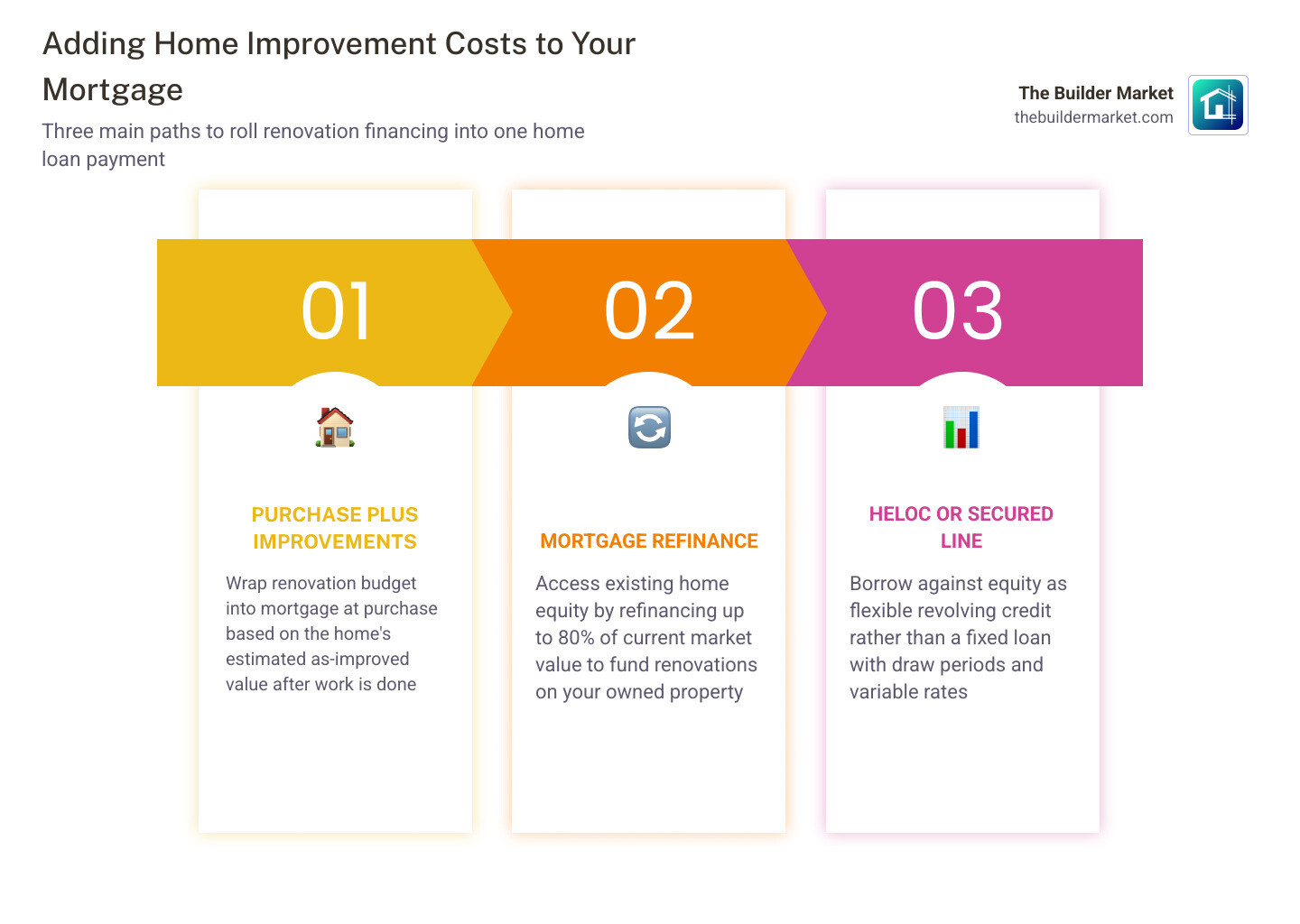
Here is a quick breakdown of the main ways to do it:
- Purchase plus improvements mortgage - wrap renovation costs into your mortgage when buying a home, based on the home's estimated value after the work is done
- Mortgage refinance - access your existing home equity by refinancing up to 80% of your home's current market value and using the difference to fund renovations
- HELOC or secured line of credit - borrow against your home equity as a flexible, revolving credit product rather than a fixed loan
Each approach has different eligibility rules, borrowing limits, and trade-offs depending on your situation.
Many homeowners hit the same wall: they find the right property or finally have a renovation plan ready, but the money to make it happen is not sitting in a savings account. A new kitchen, a finished basement, or a roof replacement can cost far more than most people have on hand. At the same time, personal loans and credit cards carry much higher interest rates than mortgage-based products — making them expensive choices for large projects.
That is exactly where mortgage-based renovation financing comes in. By tying your improvement costs to your home loan, you may be able to access lower interest rates, longer repayment periods, and a single manageable monthly payment. Programs available in Canada — including CMHC Improvement, Canada Guaranty, and Sagen — even allow eligible buyers to finance up to 95% of a home's as-improved value, meaning the lender considers what the home will be worth after renovations, not just what it is worth today.
But mortgage-based renovation financing is not the right fit for every homeowner or every project. Understanding how it works, what qualifies, and what the alternatives look like is essential before you commit.
What “Adding a Home Improvement Loan to Your Mortgage” Actually Means
When people talk about adding home improvement loan to mortgage financing, they usually mean one of three things:
- increasing or refinancing an existing mortgage to pull out funds for renovations
- buying a home with a purchase plus improvements mortgage
- using home equity through a secured product tied to the property
What it does not usually mean is taking a regular unsecured home improvement loan and magically stapling it onto your mortgage later. Lenders tend to prefer structure, paperwork, and enough forms to keep a printer emotionally fulfilled.
Home improvement loan vs renovation mortgage vs purchase plus improvements mortgage
These terms sound similar, but they are not the same.
A home improvement loan is often an unsecured personal loan used for repairs or upgrades. It usually has fixed payments and a shorter repayment period.
A renovation mortgage is a broader term for mortgage-based financing that includes improvement costs. This can apply when buying a home or when refinancing one you already own.
A purchase plus improvements mortgage is a specific product used when buying a property that needs work. The renovation budget is added to the mortgage up front, and the lender typically holds back the improvement funds until the work is completed and verified.
Key differences:
- Unsecured loan: not tied to your home, usually simpler but often carries a higher rate
- Renovation mortgage: secured by the property and usually spread over a longer amortization
- Purchase plus improvements: designed for home purchase plus renovation in one loan, often with holdback funds and completion deadlines
When adding home improvement loan to mortgage is possible
It is generally possible when:
- you are buying a home and want to include approved renovations at closing
- you already own the home and have enough equity to refinance
- your lender offers a mortgage increase, refinance, or secured borrowing option
- you meet loan-to-value, income, and credit requirements
For existing homeowners, access usually depends on equity. In many cases, refinancing is capped at up to 80% of current market value. For insured improvement programs tied to a purchase, financing can be based on the as-improved value, with eligible owner-occupied properties sometimes reaching up to 95% loan-to-value.
When a separate loan or credit product may fit better
Sometimes a mortgage add-on is not the cleanest fit.
A separate product may work better if:
- your renovation will happen in phases
- your scope is still changing
- you need money quickly for urgent repairs
- you want to borrow only what you use
- you do not want to refinance your full mortgage
That is where a HELOC, home equity loan, personal loan, or line of credit may make more sense.
How to Add a Home Improvement Loan to Your Mortgage in Canada
The exact process depends on whether you are buying, refinancing, or borrowing against equity. But the basic path is similar: define the project, prove you qualify, document the work, and get lender approval before swinging any hammers.
Option 1: Refinance an existing mortgage to fund renovations
If you already own your home, refinancing is one of the most common ways to finance larger renovations.

Here is how it usually works:
- We determine the home’s current market value.
- We calculate available equity.
- We apply to refinance the mortgage balance plus renovation funds.
- The lender reviews income, debt ratios, credit, and property value.
- If approved, the old mortgage is replaced with a new one.
This option can be useful for major projects because repayment can be spread over a longer amortization period. But refinancing may involve legal, appraisal, and closing-related costs, and it may reset your mortgage terms.
Option 2: Use a purchase plus improvements mortgage when buying a home
This is the classic fixer-upper solution.
With a purchase plus improvements mortgage:
- You buy the home.
- You submit contractor quotes and a renovation plan before closing.
- The lender approves the total mortgage based on the purchase price plus eligible improvements.
- You close on the home.
- Renovation funds are held back.
- After the work is completed and confirmed, the held-back funds are released.
These programs are usually intended for owner-occupied homes and permanent improvements. Renovation budgets are often limited to a percentage of the purchase price, commonly in the 10% to 20% range depending on the lender and insurer.
Option 3: Use home equity financing for renovations
Home equity financing usually means a HELOC or another secured line tied to your property.
This route can work well for phased or uncertain projects because:
- you draw funds as needed
- you may pay interest only on the amount used
- you can repay and re-borrow during the draw period, depending on the product
Some lenders allow access to up to 80% of the home’s value through combined mortgage and equity products, though the structure varies.
Documents, timelines, and lender steps you should expect
Expect paperwork. Then expect a little more paperwork.
Common lender requirements include:
- proof of income
- employment confirmation
- bank statements
- details of your current mortgage
- contractor quotes
- renovation plans or scope of work
- permits, if required
- property appraisal
- receipts and final inspection documents
For purchase-plus-improvement style products, renovation completion windows often range from 90 to 180 days. Some lenders may require completion within 120 days, so always confirm the timeline before closing.
Eligibility Rules, Loan Limits, and Approved Renovations
Not every borrower, property, or project qualifies. Lenders want to know both that you can repay the debt and that the renovation makes sense for the property.
Common qualification standards lenders look at
Lenders typically review:
- credit score
- income stability
- current debts
- gross debt service ratio
- total debt service ratio
- equity position or down payment
- whether the property will be owner-occupied
For some insured improvement programs in Canada, at least one borrower or guarantor may need a minimum credit score of 600. Debt service guidelines often land around 39% for GDS and 44% for TDS, though lender policy can vary.
How much you may be able to finance
This depends on the product:
- Insured improvement financing for eligible 1- or 2-unit owner-occupied homes can go up to 95% of as-improved value
- Eligible 3- or 4-unit owner-occupied homes may be limited to 90%
- Refinancing an existing home is commonly limited to 80% of current market value
- Purchase plus improvements budgets are often capped by lender rules and may fall around 10% to 20% of purchase price
For insured products, maximum amortization is often 25 years. Refinance terms can be longer in some cases, depending on the lender and loan type.
What renovations usually qualify and what often does not
Lenders prefer renovations that are permanent, clearly defined, and likely to support property value.
Commonly accepted improvements include:
- kitchen remodels
- bathroom upgrades
- roofing
- windows and doors
- flooring
- insulation
- accessibility modifications
- energy-efficiency improvements
- structural repairs
- finished basements
- plumbing, electrical, or HVAC updates
Often excluded or limited:
- appliances not permanently attached
- movable items
- luxury extras with weak resale value
- overly customized features
- work without proper permits where permits are required
How lenders decide whether renovations add value
Lenders usually rely on an appraisal based on the future or as-improved value of the home.
The appraiser may review:
- contractor scope and pricing
- drawings or plans
- comparable homes with similar updates
- the permanence of the improvements
- whether the work improves function, condition, safety, or market appeal
A new roof or an updated kitchen is easier to support than a highly personalized project that only makes sense to one future buyer and maybe their very specific pet iguana.
Mortgage-Based Renovation Financing vs HELOC, Personal Loan, and Line of Credit
No single financing route is best for every project. The right one depends on project size, timing, flexibility, and your tolerance for fees and repayment length.
Pros of rolling renovation costs into your mortgage
Main advantages include:
- potentially lower interest rates than unsecured borrowing
- one monthly payment instead of several
- longer repayment term, which can reduce monthly strain
- access to larger amounts for major projects
- useful for buyers with limited cash but strong long-term plans
For bigger renovations, this can make budgeting more predictable.
Cons and risks to weigh before committing
Mortgage-based financing also has downsides:
- you may be paying for the renovation over a much longer period
- total interest over time can be higher because of the longer amortization
- refinancing may come with fees and administrative costs
- some funds may be held back until completion
- lender timelines can create pressure
- over-improving the home can leave you spending more than the market supports
- contractor delays can affect reimbursement timing
Best use cases for HELOCs, personal loans, and lines of credit
A HELOC is often best for:
- phased renovations
- projects with uncertain final scope
- homeowners who want draw flexibility
- ongoing repairs and upgrades over time
A personal loan may fit:
- smaller, clearly priced projects
- homeowners without enough equity
- borrowers who want fixed payments and a defined payoff date
A personal line of credit may fit:
- medium-size projects
- borrowers who want flexible access to funds
- short-term borrowing with disciplined repayment
Questions to ask before choosing any financing route
Before you commit, ask:
- Is this a one-time renovation or a phased project?
- Do I know the full scope today?
- Will the work likely add value, function, or safety?
- Have I included a contingency buffer for surprises?
- Do I need to notify my home insurer before work starts?
- Do I have written contractor quotes?
- Will licensed trades and permits be required?
- What happens if the project runs past the lender’s deadline?
| Financing option | Best for | Main strength | Main caution |
|---|---|---|---|
| Mortgage refinance | Large planned renovations | Long repayment, one payment | Fees and reset of mortgage terms |
| Purchase plus improvements | Buying a fixer-upper | Combines purchase and reno costs | Holdback funds and strict timelines |
| HELOC | Phased or uncertain work | Flexible draws | Variable rate risk |
| Personal loan | Smaller defined projects | Fixed payments | Higher rate than secured borrowing |
| Personal line of credit | Medium flexible needs | Reusable credit | Requires repayment discipline |
Insured Programs, Incentives, and Practical Planning Tips
In Canada, insured improvement programs can make mortgage-based renovation financing more accessible for eligible borrowers, especially buyers.
How insured improvement programs work
Programs such as CMHC Improvement, along with similar insured options from Canada Guaranty and Sagen, are designed to let borrowers finance renovations based on the home’s projected value after completion.
Common features include:
- owner-occupied focus
- eligible 1- to 4-unit properties, with at least one owner-occupied unit in many cases
- approval based on as-improved value
- holdback release after renovation verification
- progress advances for larger projects in some cases
- typical maximum amortization of 25 years for insured loans
For CMHC Improvement, eligible 1- or 2-unit owner-occupied properties may be financed up to 95% of as-improved value. Some larger renovation budgets may qualify for staged advances if they exceed a set share of the completed value.
Government incentives and tax credits that may help
Depending on the renovation, some programs may help offset eligible costs.
Examples include:
- Home Accessibility Tax Credit for qualifying accessibility upgrades
- Multigenerational Home Renovation Tax Credit for creating a qualifying secondary suite for a family member
- energy-efficiency incentives that may vary by program and province
- a partial refund on mortgage insurance premiums for eligible energy-efficiency improvements in some cases
For example, eligible energy-efficiency upgrades may qualify for a 25% partial refund on CMHC insurance premiums. As always, confirm current rules for 2026 before relying on any incentive.
Insurance, contractor, and project-planning must-dos
Before work begins, we recommend a few non-glamorous but very smart steps:
- tell your home insurance provider about the renovation
- get written, itemized contractor quotes
- confirm whether permits are needed
- choose licensed professionals for regulated work
- define payment schedules clearly
- keep receipts, invoices, and inspection records
- build in a contingency buffer for surprises
- avoid borrowing long-term for short-lived design trends
The goal is not to remove all risk. Renovations are still renovations, which means at least one thing may go sideways. The goal is to reduce the expensive surprises.
Where to find qualified remodeling help before you finance
Before applying, it helps to have a realistic scope and contractor-ready paperwork. That is where we can help. At The Builder Market, we connect homeowners with vetted pros, project planning tools, and financing-friendly preparation so you can approach lenders with a cleaner plan.
You can also explore remodeling professionals here:
- Home Improvement Services
- Home Improvement Services
- Home Improvement Services
- Home Improvement Services
- Home Improvement Services
Frequently Asked Questions About Adding a Home Improvement Loan to Your Mortgage
Can you add renovation costs after your mortgage has already closed?
Yes, but usually not by simply editing your existing mortgage on the spot. In practice, homeowners typically use:
- a refinance
- a mortgage increase, if their lender allows it
- a HELOC or secured line of credit
- another home equity product
Whether this is worthwhile depends on available equity, lender policy, and the costs of changing the loan.
Do you need to pay for renovations upfront before holdback funds are released?
Often, yes. With many purchase plus improvements programs, the lender holds back the renovation funds until the work is completed and verified. That means you may need to cover contractor payments up front, at least temporarily, and then submit receipts, inspection reports, or an appraiser confirmation to get reimbursed.
For larger insured improvement projects, some lenders may offer progress advances instead of a single release at the end.
How long do you have to finish renovations financed through a mortgage?
There is no universal rule. Many lender timelines fall between 90 and 180 days, and some products use a 120-day completion expectation. The exact deadline depends on the lender, insurer, and project type, so confirm it before closing and build your contractor schedule around it.
Conclusion
Adding renovation costs to your mortgage can be a smart way to fund meaningful home improvements, especially when the project is well scoped, the paperwork is ready, and the upgrades truly improve the home. The key is matching the financing method to the project instead of forcing the project to fit the financing.
At The Builder Market, we help homeowners get renovation-ready by connecting them with vetted professionals, project planning support, and tools that make the next step easier to manage. If you are preparing for a remodel, addition, or major upgrade, start by getting your scope and contractor quotes in order.
For next steps and local project inspiration, explore more home improvement services here.
Need Help?
Contact us today to discuss your needs. Our team is ready to help.
About the Author
The Builder Market
More Articles
View All PostsRelated Articles
Ready to grow with The Builder Market?
Explore listings, AI growth, sites, and lead options—or talk to our team about what fits your business.

