How to Fix Broken Dishwasher Spray Arm in 5 Simple Steps
Fix your wobbly dishwasher spray arm with this 5-step DIY repair guide and restore proper water circulation.
How to Fix Broken Dishwasher Spray Arm in 5 Simple Steps
Why Dishwasher Spray Arm Repair Matters for Your Cleaning Performance
Dishwasher spray arm repair is something most homeowners can tackle themselves — and in most cases, it comes down to one of just a few common fixes.
Quick answer: How to fix a dishwasher spray arm
- Wobbly arm — Remove the lower rack, locate the center hub, and tighten it clockwise by hand.
- Arm hitting the sides or bottom — Check that the bottom center post is firmly fixed and not popping up during operation.
- Clogged nozzles — Use a needle or thin wire to clear blocked holes, then soak the arm in vinegar for 15–20 minutes.
- Damaged or cracked arm — Replace with an OEM-compatible part matched to your dishwasher's model number.
- Arm not rotating at all — Check for debris in the pump, inspect the diverter valve, and verify wash zone settings.
Your dishwasher's spray arm is the engine of its cleaning power. It spins and forces pressurized water across every dish, every cycle. When it starts wobbling, hitting the tub walls, or stops rotating entirely, your dishes stop getting clean — plain and simple.
The good news? In most cases, the fix is fast and affordable. One real-world example from a repair forum tells the story well: a homeowner with a 7-year-old KitchenAid noticed the lower spray arm knocking against the sides and bottom of the tub. The culprit? A loose center hub — a small plastic piece that had simply worn out over time. A quick tighten, or a low-cost hub replacement, was all it took.
Whether your arm is wobbly, clogged, cracked, or completely fallen off, this guide walks you through exactly what to do.
Why is my dishwasher spray arm wobbly or hitting the sides?
If you hear a rhythmic "thwack-thwack" sound during a cycle, your spray arm is likely hitting the tub walls or the bottom of the machine. As of May 2026, many modern dishwashers still rely on plastic mounting assemblies that can degrade over time.

The most common cause of a wobbly arm is a loose center wash arm hub. This hub acts as the anchor point; if it isn't snug, the arm will tilt during rotation. Other culprits include:
- Mineral Deposits: In areas with hard water, calcium and limescale can build up inside the mounting threads. This prevents the hub from seating properly, leading to a loose fit.
- Worn Threads: Because these parts are often plastic, the threads can strip or "fatigue" after years of heat cycles.
- Bottom Center Post Issues: The post that the arm sits on should be firmly fixed. If this post pops up or moves, the arm loses its plane of rotation.
- Plastic Fatigue: Over 6 or 7 years, the plastic clips or retainers can become brittle and snap, causing the arm to fall off entirely.
If you’ve noticed your dishes coming out with spots or stuck-on food, it’s time for a diagnosis and repair. A wobbly arm doesn't just make noise; it fails to distribute water at the correct pressure, leaving certain "dead zones" in your racks.
I'm looking for dishwasher spray arm repair in Elmwood Park: A 5-step DIY guide
Repairing a spray arm is a "novice" level repair that usually takes less than 15 to 30 minutes. Before you call in the pros, try these steps to restore your machine's efficiency.
Required Tools
- Needle-nose pliers: For clearing stubborn debris from nozzles.
- Flat-head screwdriver: To gently pry up locking clips.
- Multi-screwdriver/Socket set: Depending on your brand (GE, Whirlpool, Frigidaire), you may need to remove a few screws.
- White Vinegar: For soaking and dissolving mineral buildup.
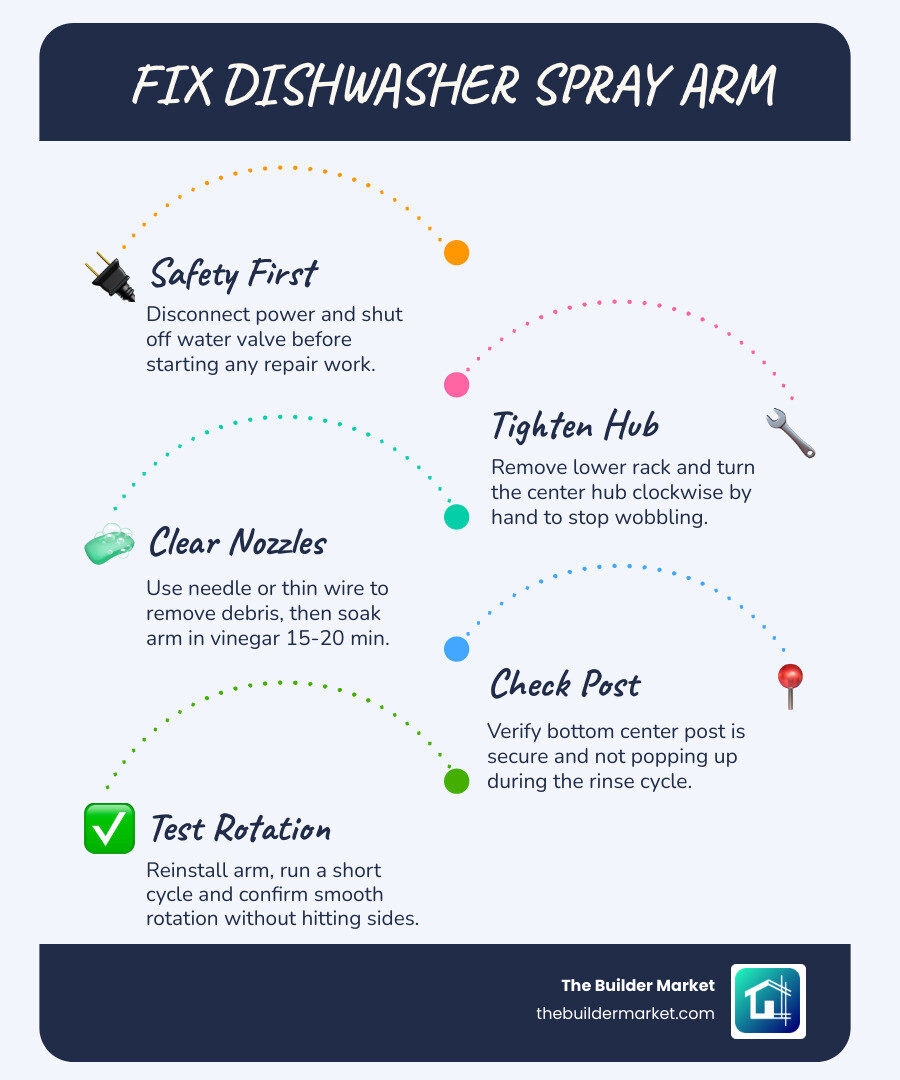
Step 1: Safety and tools for dishwasher spray arm repair
Safety first! Before reaching into the guts of any appliance, disconnect the power. You can unplug the unit or shut off the house circuit breaker. While you're at it, turn off the water supply valve usually located under the sink. This prevents any accidental "surprises" while you're working.
Step 2: Remove and Inspect
Pull out the lower dish rack to access the bottom arm. For the upper arm, you may need to unscrew a mounting nut or release a clip. Inspect the arm for cracks or melted plastic—a common issue if a stray utensil fell onto the heating element.
Step 3: Clean the Nozzles
If the arm isn't broken but just isn't cleaning, it’s likely clogged. Use a thin wire or needle to poke through each spray hole. You’d be surprised how many "clean" dishes are actually being sprayed with water through a layer of old popcorn kernels or glass shards.
Step 4: Tighten or Replace the Hub
If the arm is wobbly, turn the center hub clockwise. It should be firmly tight. If the threads are stripped and it won't stay tight, you will need to replace the hub assembly.
Step 5: The Rotation Test
Once reattached, spin the arm by hand. It should move freely without hitting the racks or the tub. Run a short rinse cycle to verify that the water pressure is spinning the arm as intended. If you're still having trouble, you might need expert appliance assistance to check deeper components like the pump.
Identifying the correct parts for dishwasher spray arm repair
When DIYing, the most critical step is getting the right part. Never "eyeball" it. Locate your dishwasher’s model number on the frame inside the door. Use that number to find genuine OEM (Original Equipment Manufacturer) parts.
In the past month alone, hundreds of homeowners have purchased these specific high-demand parts:
- 5304517203: A popular Frigidaire lower spray arm (over 800 sold recently).
- 1545680 / 154568002: Common lower wash arms for various brands.
- WD22X27724: A go-to replacement for GE models.
- 5304506660: A complete lower wash arm assembly.
Using the correct part ensures the spray pattern matches your dishwasher's internal design, which is vital for proper cleaning.
Is it worth fixing a 7-year-old unit or should I replace the hub?
Homeowners often ask: "My dishwasher is 7 years old. Should I just buy a new one?"
The answer is almost always no if the issue is just the spray arm. A spray arm or hub assembly is a fraction of the cost of a new machine. However, you should weigh the repair against the overall health of the unit.
| Component | Repair Difficulty | Worth it for a 7-year-old unit? |
|---|---|---|
| Spray Arm Hub (W10077898) | Easy | Yes - Very inexpensive fix. |
| Upper Arm Kit (675808) | Easy | Yes - Restores top-rack cleaning. |
| Clip-on Upper Arm (WPW10317197) | Easy | Yes - Modern design simplifies install. |
| Circulation Pump | Hard | Maybe - Depends on the overall condition. |
| Diverter Valve | Moderate | Yes - If the rest of the unit is quiet. |
If the motor is humming but the arms aren't moving, you might have a mechanical failure in the circulation pump or a stuck diverter valve. If the machine is otherwise in good shape, replacing these parts is a sustainable and cost-effective choice compared to a full replacement.
How can I prevent my dishwasher spray arm from clogging again?
Once you've completed your dishwasher spray arm repair, you want to make sure you don't have to do it again next month.
- Scrape, Don't Pre-Wash: You don't need to rinse your dishes to a shine, but you must scrape off solid food. Seeds, bone fragments, and heavy grease are the primary causes of nozzle clogs.
- Use a Cleaner: Products like affresh or a simple cup of white vinegar run through a hot cycle once a month can dissolve limescale before it hardens in the hub threads.
- Check the Filter: A clogged dishwasher filter sends debris right back into the spray arms. Clean your filter every few weeks.
- Detergent Dosage: Using too much detergent can leave a sticky residue that traps food particles inside the arm. Follow the manufacturer's guidelines for your water hardness level.
Frequently Asked Questions
Why is only one spray arm rotating in my dishwasher?
This is often due to the diverter valve. Many modern dishwashers alternate water flow between the top and bottom arms to maximize pressure. If the valve is stuck, or if you have "Wash Zone" settings enabled that target only one rack, one arm will remain still. It could also be a sign of a damaged pump impeller or a physical blockage (like a fallen spoon) stopping the arm.
How do I know if my spray arm hub is worn out?
Perform the "wobble test." With the machine off, gently wiggle the spray arm. If it tilts significantly or feels like it’s barely hanging on, the hub or the center post is likely worn. You can try tightening it clockwise, but if it doesn't "bite" and stay tight, the plastic threads are stripped.
Can I clean a spray arm without removing it?
You can do a surface clean with a needle or thin wire to poke out debris from the holes. However, for a deep clean, it’s best to remove it. Removing the arm allows you to shake out trapped debris from the center inlet and give it a thorough vinegar soak to remove hidden mineral buildup.
Conclusion
A dishwasher that doesn't wash is just an expensive drying rack. Fortunately, dishwasher spray arm repair is one of the most straightforward DIY tasks you can perform. By tightening a loose hub, clearing out clogs, or replacing a cracked arm with a genuine OEM part, you can extend the life of your appliance by years.
At The Builder Market, we know that home maintenance can feel overwhelming. That’s why we’ve built an AI-powered platform to connect you with vetted, local professionals who can handle everything from appliance repair to full kitchen remodels. Whether you're in Chicago, Phoenix, or Elmwood Park, we help you find the right pro for the job.
If your DIY repair reveals a bigger issue—like a failing motor or a leaky diverter—don't sweat it. Find a local appliance repair pro today and get your kitchen back in working order.
Need Help?
Contact us today to discuss your needs. Our team is ready to help.
About the Author
The Builder Market
More Articles
View All PostsRelated Articles
Ready to grow with The Builder Market?
Explore listings, AI growth, sites, and lead options—or talk to our team about what fits your business.

