The Most Effective Solution for Furnace Repair Service
Get expert furnace repair service for reliable winter heating, safety checks, and system longevity.
The Most Effective Solution for Furnace Repair Service
When Your Heat Stops Working: What Every Homeowner Should Know About Furnace Repair Service
Getting a reliable furnace repair service when your heat goes out — especially in the middle of winter — can feel overwhelming. Before you dig into the full guide, here's a quick summary of what most homeowners need to know right away:
Quick Answer: Furnace Repair Service at a Glance
| Question | Short Answer |
|---|---|
| Top signs you need repair | No heat, strange noises, short cycling, yellow pilot light, rising energy bills |
| First steps to take | Check thermostat settings, replace the filter, check circuit breaker, look for error codes |
| When to call immediately | Gas smell, carbon monoxide alarm, yellow or orange flame |
| Repair vs. replace rule | If furnace age × repair cost exceeds $5,000, replacement is usually the smarter move |
| How fast can pros respond | Many HVAC professionals offer same-day or emergency 24/7 service |
| How often to service | Once a year, ideally before heating season begins |
It's easy to forget about your furnace — until the day it stops working and your home drops to an uncomfortable temperature fast. One common scenario that HVAC professionals hear about regularly: a homeowner wakes up on a cold morning to find the inside of their house hovering around 52°F, with no heat running at all. That moment of panic is exactly why knowing your options ahead of time matters.
A well-maintained furnace can last anywhere from 15 to 20 years. But even reliable systems develop problems — from dirty flame sensors and failing ignitors to cracked heat exchangers and worn blower motors. The good news is that most issues, when caught early, are straightforward to fix.
This guide walks you through everything: how to spot the warning signs, what to check yourself, when to call a pro, and how to decide whether a repair or full replacement makes the most financial sense.
Identifying Common Signs You Need a Furnace Repair Service

Spotting trouble early can be the difference between a quick fix and a total system failure. Your furnace is the heart of your home's comfort during the colder months, and it usually gives off several warning signals before it gives up entirely.
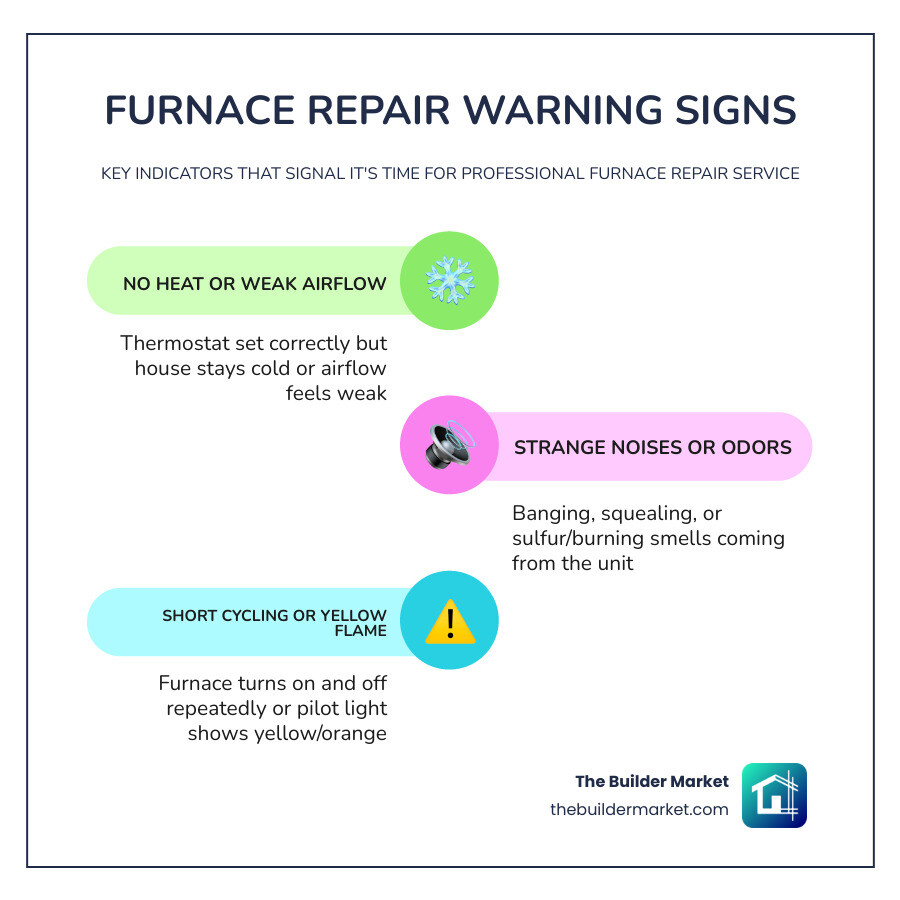
Common indicators that you need to call for a furnace repair service include inconsistent heating across different rooms, a sudden spike in your monthly utility bills, or a pilot light that has changed color. If you notice that your furnace is running constantly but the house never feels quite warm enough, you likely have an airflow or combustion issue. To learn more about how these components work together, you can explore our guide on Heating Furnace Systems.
Recognizing Unusual Noises and Smells
Your furnace should operate relatively quietly. While a soft hum is normal, certain sounds are a cry for help:
- Banging or Booming: This often indicates "delayed ignition." Gas builds up because the burners are dirty, and when it finally catches, it creates a small explosion that can eventually crack your heat exchanger.
- Squealing or Screeching: This usually points to a failing blower motor belt or bearings that need lubrication.
- Rattling: Loose panels or a failing motor mount are common culprits here.
Smells are equally important. A faint "dusty" smell when you first turn the heat on in the fall is normal. However, a persistent sulfur or rotten egg odor is a sign of a gas leak. A burning plastic or electrical smell suggests overheating components or wiring issues. If you smell gas, leave the home immediately and call your utility company or a professional.
Understanding Short Cycling and Airflow Issues
"Short cycling" is a technical term for when your furnace turns on and off too frequently. A standard furnace should typically run two to three cycles per hour, lasting about 10 to 15 minutes each. If yours is clicking on every five minutes and then shutting down, it’s likely overheating.
This is often caused by a clogged air filter. When air can't flow through the system, the internal temperature rises, and a safety limit switch shuts the furnace down to prevent a fire. Other causes include a malfunctioning thermostat, a dirty flame sensor, or an improperly sized furnace for the home. Weak airflow from your vents can also signal that the blower motor is struggling or that there are leaks in your ductwork.
Critical Safety Concerns and Troubleshooting Steps
Safety is the most critical aspect of furnace ownership. Because most furnaces use combustion (burning gas or oil) to create heat, they naturally produce carbon monoxide (CO). A healthy furnace vents these gases safely outside, but a cracked heat exchanger or blocked vent can allow CO to leak into your living space.
One of the easiest ways to monitor safety is by looking at the flame. Use the table below to understand what your furnace flame color is telling you:
| Flame Color | Meaning | Action Required |
|---|---|---|
| Steady Blue | Proper combustion; healthy oxygen-to-gas ratio. | No action needed; continue regular maintenance. |
| Yellow or Orange | Incomplete combustion; presence of dirt, moisture, or minerals. | Call for service. This can indicate a CO risk. |
| Flickering or Weak | Draft issues or burner problems. | Have a professional inspect the ventilation and burners. |
What to Check Before Calling for Furnace Repair Service
Before you call for an emergency furnace repair service, perform these quick checks. You might save yourself a service fee:
- The Thermostat: Ensure it is set to "Heat" and the temperature is at least 5 degrees above the current room temperature. If the screen is blank, replace the batteries.
- The Air Filter: A filthy filter is the #1 cause of furnace "breakdowns." If it looks gray or furry, replace it.
- Power Switches: Check the "service switch" (it looks like a light switch on the side of the furnace) and your home's circuit breaker panel.
- The Gas Valve: Ensure the gas line handle is in the "on" position (parallel to the pipe).
- LED Error Codes: Most modern furnaces have a small window where a blinking light provides a code. Count the blinks and check the chart on the inside of the furnace panel; this info helps your technician arrive prepared.
Emergency Response and Safety Protocols
If your carbon monoxide detector goes off, or if you smell a strong odor of gas, do not stop to troubleshoot. Open the windows if possible, get everyone out of the house, and call 911 or your local gas provider from outside.
True emergencies—like a total loss of heat when temperatures are below freezing—require 24/7 response. In extreme cold, your pipes are at risk of bursting if the home temperature drops too low. Many professionals prioritize "no-heat" calls during winter storms to ensure family safety.
The Financial Decision: Should You Repair or Replace?
One of the toughest questions homeowners face is whether to keep patching up an old unit or invest in a new one. To take the emotion out of the decision, many experts use the $5,000 Rule.
Multiply the age of your furnace by the cost of the repair. If the total is more than $5,000, it is usually more cost-effective to replace the unit. For example:
- A 12-year-old furnace with a $300 repair = $3,600 (Repair it).
- A 15-year-old furnace with an $800 repair = $12,000 (Replace it).
Evaluating the Lifespan of Your Heating System
Most gas furnaces are designed to last 15 to 20 years. Electric furnaces can sometimes push past 25 years. As a system ages, its efficiency naturally declines, and parts become harder to source. If you find yourself calling for furnace repair service more than once a year, or if your energy bills have climbed 20% without a change in usage, your system is likely nearing the end of its functional life.
Major component failures, such as a cracked heat exchanger or a dead blower motor, are often the "final straw" for older units. Because the heat exchanger is a safety-critical part, a crack usually means the unit must be shut off immediately, making replacement the only viable path forward.
Benefits of Upgrading to Modern Furnace Repair Service Standards
Choosing a new installation over a repair comes with significant long-term perks:
- Lower Utility Bills: Modern high-efficiency furnaces (AFUE ratings of 95% or higher) use significantly less fuel than older 80% models.
- Reliability: A new system comes with a manufacturer’s warranty (often 10 years for parts) and a labor warranty from the installer.
- Smart Technology: Newer systems integrate seamlessly with smart thermostats and "zone" controls, allowing you to heat only the rooms you are using.
- Improved Air Quality: Modern blowers can run at variable speeds, providing better filtration and more consistent humidity levels.
Maximizing Longevity Through Regular Maintenance
The best way to avoid an emergency furnace repair service call is to prevent the problem before it starts. Industry data shows that 95% of unexpected breakdowns could have been prevented with regular maintenance.
We recommend an annual professional tune-up every September or October, before the heavy heating season begins. Think of it like an oil change for your car; you wouldn't drive 50,000 miles without maintenance, and your furnace shouldn't run for 1,000 hours a year without a check-up.
Why Professional Maintenance Prevents Breakdowns
During a professional maintenance visit, a technician does more than just look at the unit. They perform a series of critical tasks:
- Combustion Analysis: Testing the gases to ensure the furnace is burning fuel cleanly and safely.
- Cleaning the Burners and Flame Sensor: Removing carbon buildup that causes ignition failure.
- Inspecting the Heat Exchanger: Using specialized cameras to look for microscopic cracks that could leak carbon monoxide.
- Lubricating Moving Parts: Reducing friction in the blower motor to extend its life.
- Testing Safety Limits: Ensuring that if the furnace does overheat, it will shut down correctly.
Frequently Asked Questions about Furnace Repair
How often should I change my furnace filter? For standard 1-inch filters, every 1 to 3 months. If you have pets or allergies, check it monthly. High-efficiency 4-inch pleated filters can often last 6 to 12 months.
My pilot light is yellow. Is that a problem? Yes. A healthy gas flame should be blue. A yellow or orange flame indicates that the gas isn't burning completely, which can produce carbon monoxide. You should call for service immediately.
Why does my furnace make a loud bang when it starts? This is usually caused by dirty burners. The gas doesn't ignite immediately, builds up, and then "pops" when it finally catches. This can damage the heat exchanger over time.
Can I repair my own furnace? While you can change filters and check thermostats, you should never attempt to repair gas valves, heat exchangers, or electrical control boards yourself. These involve high-voltage electricity and combustible gas, which require professional tools and training to handle safely.
Conclusion
Maintaining a comfortable home shouldn't be a source of stress. Whether you are dealing with a sudden breakdown or simply want to ensure your system is ready for the first frost, getting the right professional help is key.
At The Builder Market, we specialize in connecting homeowners with vetted, high-quality professionals across the country. Our AI-powered matching system takes the guesswork out of home improvement, allowing you to find a pro who is the perfect fit for your specific project. From emergency repairs to full system upgrades, we provide the tools you need for direct communication and project management.
Ready to ensure your home stays warm all winter? Find a professional for your home addition or remodeling project and experience the easiest way to manage your home's vital systems.
Need Help?
Contact us today to discuss your needs. Our team is ready to help.
About the Author
The Builder Market
More Articles
View All PostsRelated Articles
Ready to grow with The Builder Market?
Explore listings, AI growth, sites, and lead options—or talk to our team about what fits your business.

