The Ultimate Guide to Comparing Home Improvement Loan Options
Compare HELOCs, personal loans, and government programs to find the best way to borrow money for home improvement.
The Ultimate Guide to Comparing Home Improvement Loan Options
Why Finding the Best Way to Borrow Money for Home Improvement Matters More Than Ever
The best way to borrow money for home improvement depends on three things: how much you need, how much equity you have, and how fast you need the funds. Here is a quick breakdown to match your situation to the right option:
| Your Situation | Best Financing Option |
|---|---|
| Have 20%+ home equity, large project | HELOC or home equity loan |
| No equity, need funds fast | Unsecured personal loan |
| Buying a fixer-upper, limited equity | FHA 203(k) loan |
| Small project, can pay off quickly | 0% APR credit card |
| Low income, rural area, or bad credit | FHA Title I or USDA Section 504 loan |
| Have the cash available | Pay cash — it is always the cheapest option |
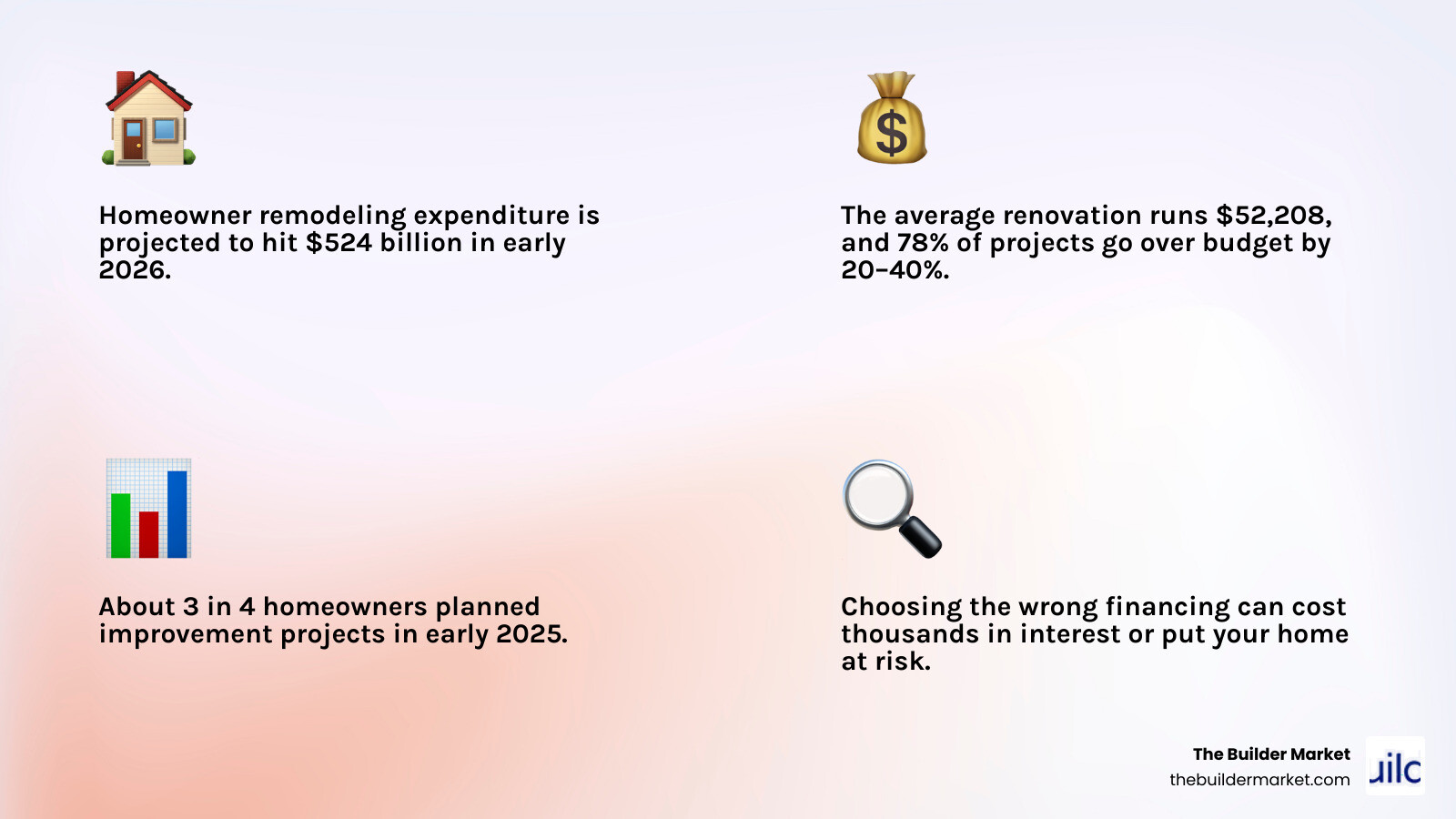
Home renovation spending is at record levels. Total homeowner remodeling expenditure is projected to hit $524 billion in early 2026, and about three in four homeowners were planning some kind of improvement project in early 2025. Yet choosing the wrong financing method can quietly cost you thousands of dollars in unnecessary interest — or worse, put your home at risk.
The average renovation runs $52,208, and roughly 78% of projects go over budget by 20% to 40%. That means the financing decision is not a small detail. It is often the difference between a project that builds wealth and one that creates lasting debt stress.
This guide breaks down every major loan option side by side — HELOCs, home equity loans, personal loans, cash-out refinances, and government-backed programs — so you can match the right tool to your project, your credit profile, and your financial goals.
Easy best way to borrow money for home improvement glossary:
- home renovation financing
- adding home improvement loan to mortgage
- best home improvement loans 2026
Evaluating the Best Way to Borrow Money for Home Improvement
Before we jump into specific loan products, we must evaluate the core decision every homeowner faces: should you pay cash, or is it wiser to borrow?
Paying cash is always the thriftiest way to finance any home project because you avoid interest charges, origination fees, and closing costs entirely. However, completely draining your liquid savings for a renovation is a high-risk move. If you wipe out your emergency fund to build a beautiful new deck, you leave yourself highly vulnerable to unexpected life events like medical bills or job loss.
As a general rule, we recommend keeping three to six months of essential living expenses untouched in a high-yield savings account. If paying cash would dip into that crucial safety net, borrowing becomes a highly practical alternative.
To determine the best way to borrow money for home improvement, you must first define your project's scope and urgency:
- Emergency Repairs: If your roof is actively leaking or your HVAC system fails in the dead of winter, speed is your primary priority. You cannot wait weeks for a home appraisal.
- Planned, Single-Scope Projects: If you are replacing all your windows or installing new siding, you have a fixed, predictable budget. A lump-sum, fixed-rate loan is often the perfect fit.
- Ongoing, Multi-Phase Renovations: If you are tackling a whole-house remodel over several months or years, your expenses will be staggered. A flexible, revolving line of credit makes the most financial sense.
Before committing to any route, we highly recommend working with a professional to map out a realistic project timeline and secure detailed bids. Connecting with a trusted General Contractor in Seattle, WA or in your local area is the smartest first step to ensure your budget is built on reality, not optimism.
Why Home Equity is Often the Best Way to Borrow Money for Home Improvement
If you have lived in your home for several years, you have likely built up significant home equity. Tapping into this equity is widely considered the best way to borrow money for home improvement for large-scale projects because it offers the lowest interest rates on the market.
Because these loans are secured by your home, lenders view them as low-risk, allowing them to offer interest rates that are significantly lower than unsecured personal loans or credit cards. There are two primary ways to borrow against your equity:
- Home Equity Line of Credit (HELOC): A HELOC works like a credit card secured by your home. You are approved for a maximum credit limit and can draw funds as needed during a set "draw period" (typically 10 years), during which you usually only owe interest on the amount you actually borrow. Once the draw period ends, you enter the repayment period (typically 20 years) and pay back both principal and interest.
- Home Equity Loan: Also known as a second mortgage, this option provides a lump-sum payment upfront with a fixed interest rate and a structured repayment schedule (usually 5 to 30 years). Your monthly payments remain identical from day one to the end of the loan.
While equity products are incredibly cost-effective, they come with two major caveats. First, they carry foreclosure risk. If you default on your payments, the lender can seize your home. Second, the application process is slow. It requires home appraisals, extensive financial documentation, and closing costs, often taking two to six weeks to fund.
If you are planning a major structural change, such as a premier Addition Remodeling in Los Angeles, CA, the low interest rates of an equity-backed loan make the setup time and paperwork well worth the effort.
Is an Unsecured Personal Loan the Best Way to Borrow Money for Home Improvement?
If you do not have much equity in your home—or if you simply do not want to use your property as collateral—an unsecured personal loan (often marketed specifically as a "home improvement loan") is an excellent alternative.
Because these loans are unsecured, the lender cannot foreclose on your home if you fall behind on payments. Instead, lenders qualify you based on your credit score, debt-to-income (DTI) ratio, and financial history.
Here is why many homeowners prefer unsecured personal loans:
- Incredible Speed: While equity products take weeks to close, personal loans can be approved and funded in as little as 24 to 48 hours.
- Predictable Payments: Personal loans almost always feature fixed interest rates and fixed monthly payments, making them incredibly easy to budget for.
- No Collateral Risk: Your home is completely safe from foreclosure, which provides immense peace of mind.
The primary drawback of an unsecured loan is the cost. Because the lender takes on more risk, personal loan interest rates are typically several percentage points higher than HELOC or home equity loan rates. Additionally, borrowers with fair or poor credit may face steep origination fees (ranging from 1% to 12% of the loan amount), which are deducted directly from the loan payout.
For mid-sized, immediate upgrades—such as updating your plumbing or remodeling a Kitchen in Tampa, FL—an unsecured personal loan offers a fantastic balance of speed, safety, and simplicity.
Comparing Home Equity Products vs. Unsecured Personal Loans
To help you visualize the structural differences between these borrowing methods, we have broken down the key features of HELOCs, home equity loans, and personal loans side by side:
| Feature | HELOC | Home Equity Loan | Unsecured Personal Loan |
|---|---|---|---|
| Collateral Required | Yes (Your Home) | Yes (Your Home) | No |
| Interest Rate Type | Variable (Tied to Prime) | Fixed | Fixed |
| How Funds are Disbursed | Revolving line of credit | One-time lump sum | One-time lump sum |
| Funding Speed | 2 to 6 weeks | 2 to 6 weeks | 1 to 3 business days |
| Typical Repayment Term | 10-year draw, 20-year repay | 5 to 30 years | 1 to 7 years |
| Foreclosure Risk | High | High | None |
| Tax Deductibility | Yes (If itemized & used for capital improvements) | Yes (If itemized & used for capital improvements) | No |
Choosing between these options often comes down to a simple decision framework:

If you are replacing a roof with a local professional, such as a specialist in Roofing in Houston, TX, and you want the job completed before the stormy season, a personal loan wins on speed. If you have plenty of equity and are planning a slow, multi-stage renovation, a HELOC will save you the most money over the long term.
Government-Backed Renovation Programs for Limited Equity
What happens if you need to make critical repairs but have limited equity or a less-than-perfect credit score? Fortunately, the federal government offers several specialized programs designed to act as a financial safety net for homeowners who cannot qualify for traditional private financing.
- FHA Title I Property Improvement Loans: These loans are insured by the Federal Housing Administration (FHA) and are specifically designed for light renovations and safety repairs. The standout benefit of Title I loans is that no home equity is required. If you recently purchased your home and have not built up equity, you can still borrow up to $25,000 for a single-family home. Even better, for loans under $7,500, no collateral is required at all.
- FHA 203(k) Rehabilitation Mortgages: If you are purchasing a fixer-upper—or refinancing your existing mortgage to fund a massive renovation—an FHA 203(k) loan is an incredibly powerful tool. Instead of basing your borrowing power on your home's current value, this program bases it on the estimated after-repair value (ARV) of the property. This allows you to roll both the purchase price (or existing mortgage balance) and the entire renovation cost into a single, low-interest mortgage with one monthly payment.
- USDA Section 504 Home Repair Program: Designed specifically for very low-income homeowners in designated rural areas, this program offers incredibly affordable loans at a fixed 1% interest rate with a 20-year term to help repair, improve, or modernize homes to remove health and safety hazards.
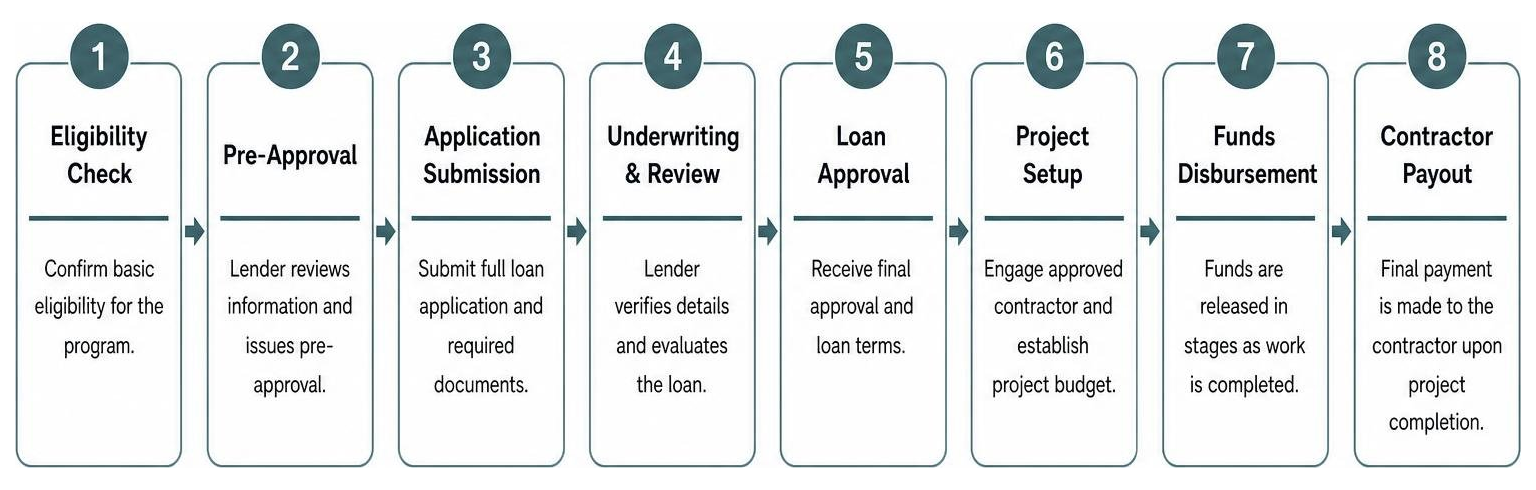
These government programs are highly structured and require working with approved lenders and, in some cases, registered HUD consultants. If you are designing structural changes with an Architect in New York, NY or planning a rural safety upgrade, exploring these government-backed pathways can unlock highly affordable financing that private banks simply cannot match.
Key Factors to Consider Before Applying
Before you submit an application to any lender, you must prepare your financial profile and project plans. Taking these steps in order will maximize your chances of approval and protect you from costly mistakes:
- Check Your Credit Score: Pull your credit reports from the major bureaus and dispute any errors immediately. For prime rates on personal loans and equity products, lenders typically look for a FICO score of 680 to 700+. If your score is lower, you can still find fair-credit lenders or government programs, but your interest rates will be higher.
- Calculate Your Debt-to-Income (DTI) Ratio: Lenders want to see that your monthly debt payments (including your mortgage, car loans, credit cards, and the proposed new loan payment) consume less than 43% of your gross monthly income.
- Secure Detailed Contractor Quotes: Never apply for a loan based on a rough estimate. Secure at least three written, itemized bids from licensed and insured professionals. This ensures you borrow the exact amount you need.
- Build in a Contingency Buffer: Approximately 78% of renovations face unexpected structural or material cost increases. Always add a 10% to 20% contingency buffer to your borrowing target so you do not run out of money mid-project.
- Understand the Tax Implications: If you choose a HELOC or home equity loan, keep meticulous records of all contractor invoices and material receipts. The IRS only allows you to deduct the interest on these loans if the funds were used to "substantially improve" the home securing the loan, and you must itemize your deductions to claim it.
Frequently Asked Questions About Home Renovation Financing
Can I write off the interest on a home equity loan?
Yes, but only under strict IRS guidelines. According to IRS Publication 936, the interest paid on a home equity loan or HELOC is tax-deductible only if the borrowed funds are used to buy, build, or "substantially improve" the specific home that secures the loan. A substantial improvement is defined as an upgrade that adds value, prolongs the home's useful life, or adapts it to new uses.
Additionally, you must itemize your deductions on your tax return to claim this benefit. Because only about 10% of U.S. taxpayers itemize their deductions (with the vast majority taking the standard deduction), this tax break helps far fewer borrowers than most standard articles imply.
How can I finance home improvements with bad credit?
If you have bad credit, you still have several viable options:
- FHA Title I and 203(k) Loans: These government-backed programs have highly flexible credit requirements, often accepting scores down to 580 (and sometimes lower with a larger down payment or existing equity).
- Credit Unions: Local credit unions and Community Development Financial Institutions (CDFIs) often look beyond standard credit scores and offer more flexible, character-based underwriting than national banks.
- Add a Co-Signer: Applying with a co-signer who has excellent credit can help you secure approval and a significantly lower interest rate.
- Secured Loans: If you have built up solid home equity, some lenders are willing to approve a home equity loan or HELOC despite a lower credit score because the loan is backed by your property.
What is a draw schedule for renovation loans?
A draw schedule is a structured timeline of payments made to your contractor throughout the renovation process. Instead of releasing the entire loan amount upfront, the lender holds the funds in an escrow account and releases them in "draws" (typically 3 to 5 installments) only after specific, pre-determined phases of construction are completed and verified by an inspector.
This protects both you and the lender from contractor abandonment and ensures the work is completed to professional standards before the final payment is released.
Conclusion
Finding the best way to borrow money for home improvement is all about matching the right financial tool to the scale, timeline, and urgency of your project. Whether you choose the speed of an unsecured personal loan, the low rates of a HELOC, or the accessibility of a government-backed program, taking the time to plan your budget and protect your home equity is the key to a stress-free renovation.
At The Builder Market, we believe that connecting with the right professionals shouldn't be the hardest part of your project. As the first AI-powered online marketplace built for real homeowners and real projects, we streamline the entire process. Our platform seamlessly connects you with vetted, local professionals across the country while offering direct communication, project management tools, and tailored financing solutions to bring your vision to life.
Ready to take the next step? Connect with trusted, background-checked specialists and explore smart, customized solutions for your next project, like a beautiful Addition Remodeling in Wasilla, AK or an upgrade right in your neighborhood.
Need Help?
Contact us today to discuss your needs. Our team is ready to help.
About the Author
The Builder Market
More Articles
View All PostsRelated Articles
Ready to grow with The Builder Market?
Explore listings, AI growth, sites, and lead options—or talk to our team about what fits your business.

