All About Conventional Loans for Fixer-Upper Homes
Learn how a conventional loan for fixer upper home funds renovations with Fannie Mae and Freddie Mac programs, from appraisal to completion.
All About Conventional Loans for Fixer-Upper Homes
Why a Conventional Loan for a Fixer-Upper Home Might Be Your Smartest Move in 2026
A conventional loan for a fixer-upper home lets you finance both the purchase price and the cost of renovations in a single mortgage — no need for two separate loans or two sets of closing costs. If you've been priced out of move-in-ready homes or want more house for your money, this financing path is worth understanding.
Here's a quick overview of how it works:
- What it is: A conventional renovation loan combines your home purchase and repair budget into one mortgage, based on the home's projected as-completed value — not its current condition.
- Main programs: Fannie Mae HomeStyle Renovation and Freddie Mac CHOICERenovation (plus the smaller CHOICEReno eXPress for minor repairs).
- Minimum credit score: Typically 620 or higher.
- Down payment: As low as 3% for first-time buyers, 5% for repeat buyers on a primary residence.
- Renovation cap: Up to 75% of the as-completed appraised value.
- Who can use it: Primary residence buyers, second-home buyers, and in some cases, investors (single-unit properties).
- Luxury upgrades: Allowed — unlike most government-backed renovation loans.
- Completion timeline: Generally 15 months or less depending on the program.
The housing market in 2026 is competitive. Fixer-uppers often sit longer on the market and sell for less than comparable move-in-ready homes — sometimes 15–20% less. For buyers who are willing to take on a project, a conventional renovation loan can turn that discount into real equity. The catch is that the process is more involved than a standard mortgage, and knowing the rules upfront makes all the difference.
Basic conventional loan for fixer upper home terms:
- adding home improvement loan to mortgage
- construction loan for fixer upper
- home renovation financing
Understanding the Conventional Loan for Fixer Upper Home
When we think of buying a house that needs some extra love, we often assume we have to pay cash for the repairs or take out a high-interest personal loan after closing. However, a conventional renovation loan changes the game entirely.
Unlike a standard mortgage, which requires the property to meet strict habitability standards on day one, a conventional renovation loan is designed specifically for properties with deferred maintenance, safety issues, or outdated designs. Under a standard conventional mortgage, if a home has a failing roof, outdated electrical systems, or plumbing leaks, the lender's underwriter will likely reject the loan because the property condition does not meet their minimum standards.
With a conventional renovation loan, the lender looks past the current state of the property. Instead of valuing the home in its "as-is" condition, they base the loan amount on the "as-completed" value. This is the projected market value of the home after all your planned renovations are finished.
Before you even close on the property, you must schedule a professional Home Inspection to identify all necessary structural, safety, and cosmetic upgrades. This ensures you know exactly what needs to be fixed and can build an accurate renovation budget to present to your lender.
Conventional Renovation Loan Programs
Two major government-sponsored enterprises, Fannie Mae and Freddie Mac, back the conventional renovation loan programs available today. These programs allow you to bundle your purchase and rehabilitation costs into a single, long-term mortgage.
Fannie Mae HomeStyle Renovation
The Fannie Mae HomeStyle Renovation loan is one of the most popular and flexible options on the market. It can be used for a wide range of property types, including primary residences, one-unit second homes, and one-unit investment properties. It even allows for the renovation of manufactured housing, though there are specific restrictions (such as limiting renovation costs to 50% of the as-completed appraised value for manufactured homes).
Key features of the HomeStyle Renovation loan include:
- Renovation Limits: You can finance renovation costs up to 75% of the lesser of the purchase price plus renovation costs, or the "as-completed" appraised value.
- Time Limits: All renovation work must typically be completed within 15 months of the loan closing date.
- Contingency Reserves: Lenders require a contingency reserve of 10% to 15% of the renovation costs to cover unexpected expenses that arise once walls are opened up.
- Allowable Costs: The loan can cover soft costs such as architectural fees, engineering fees, permit costs, and even up to six months of mortgage payments if you cannot live in the home during construction.
Freddie Mac CHOICERenovation and CHOICEReno eXPress
Freddie Mac offers its own suite of renovation products. The flagship program is CHOICERenovation, which works very similarly to Fannie Mae's offering. It allows you to finance renovations up to 75% of the total loan amount and is ideal for major structural overhauls, including updating an old roof by hiring a professional Roofing contractor.
For smaller projects, Freddie Mac offers CHOICEReno eXPress. This is a streamlined loan program designed for minor repairs and cosmetic updates, such as a quick Bathroom Remodeling project.
- Renovation Limits: CHOICEReno eXPress limits renovation costs to 10% or 15% of the home's value (depending on the property type).
- No Consultant Required: It bypasses many of the complex administrative requirements of larger renovation loans, making it faster and easier to close.
- Completion Timelines: Because the projects are smaller, the completion timeline is generally shorter, typically requiring work to be completed within 180 days.
Requirements and Eligible Repairs

Getting approved for a conventional loan for a fixer-upper home requires meeting specific financial criteria and ensuring your planned repairs are eligible under program guidelines.
How to Qualify for a Conventional Loan for Fixer Upper Home
Because these loans carry more moving parts than standard mortgages, lenders scrutinize your financial profile carefully:
- Credit Score: While government-backed loans like FHA 203(k) allow credit scores down to 580, conventional renovation loans typically require a minimum credit score of 620. Borrowers with scores of 680 or higher will secure the best interest rates and terms.
- Down Payment: First-time homebuyers can qualify with a down payment as low as 3% on a primary residence. Repeat buyers typically need at least 5% down. If you are purchasing a second home or an investment property, expect down payment requirements to range from 10% to 15% or more.
- Debt-to-Income (DTI) Ratio: Your DTI ratio should generally be below 45%, though some lenders may allow up to 50% with strong compensating factors, such as high cash reserves.
- Contractor Quotes: You cannot simply guess the cost of your renovations. You must provide formal, detailed bids from licensed professionals for major structural upgrades, including Plumbing and Electrical work.
Eligible Upgrades and DIY Rules
One of the biggest advantages of conventional renovation loans over government-backed options is the sheer flexibility of eligible repairs. Government loans often restrict "luxury" upgrades, but conventional programs allow almost any repair or improvement that is permanently affixed to the property and adds value.
Eligible projects include:
- Structural alterations and additions.
- Complete kitchen and bathroom remodels.
- New HVAC systems, roofing, and siding.
- Landscaping, decks, and luxury upgrades like in-ground swimming pools or accessory dwelling units (ADUs).
- Cosmetic updates like professional Painting and drywall repair.
The DIY and "Sweat Equity" Rules
Many homeowners love the idea of saving money by doing the work themselves. However, conventional renovation loans have very strict rules regarding DIY work:
- Fannie Mae HomeStyle allows DIY projects, but they are strictly limited to 10% of the completed value of the home.
- Any DIY work must be pre-approved by the lender, and you cannot be paid for your own labor (sweat equity is not reimbursed). You can only receive reimbursement for documented material costs.
- For complex tasks or safety-related projects, lenders will require you to hire certified professionals to ensure the work meets local building codes.
The Appraisal and Renovation Process
Navigating the appraisal and construction phases is where a conventional renovation loan differs most from a traditional home purchase.
The As-Completed Appraisal
Once you go under contract on a fixer-upper, your lender will order an "as-completed" appraisal.
The appraiser does not just look at the home's current, run-down state. Instead, they review your contractor's detailed scope of work, architectural plans, and material specifications. Using this information, the appraiser finds comparable sales of recently renovated, move-in-ready homes in the immediate neighborhood to estimate what the home will be worth after your planned projects are finished.
This as-completed appraised value is highly beneficial because it allows you to borrow against the future equity of the property, giving you the purchasing power to finance extensive renovations that would otherwise be impossible.
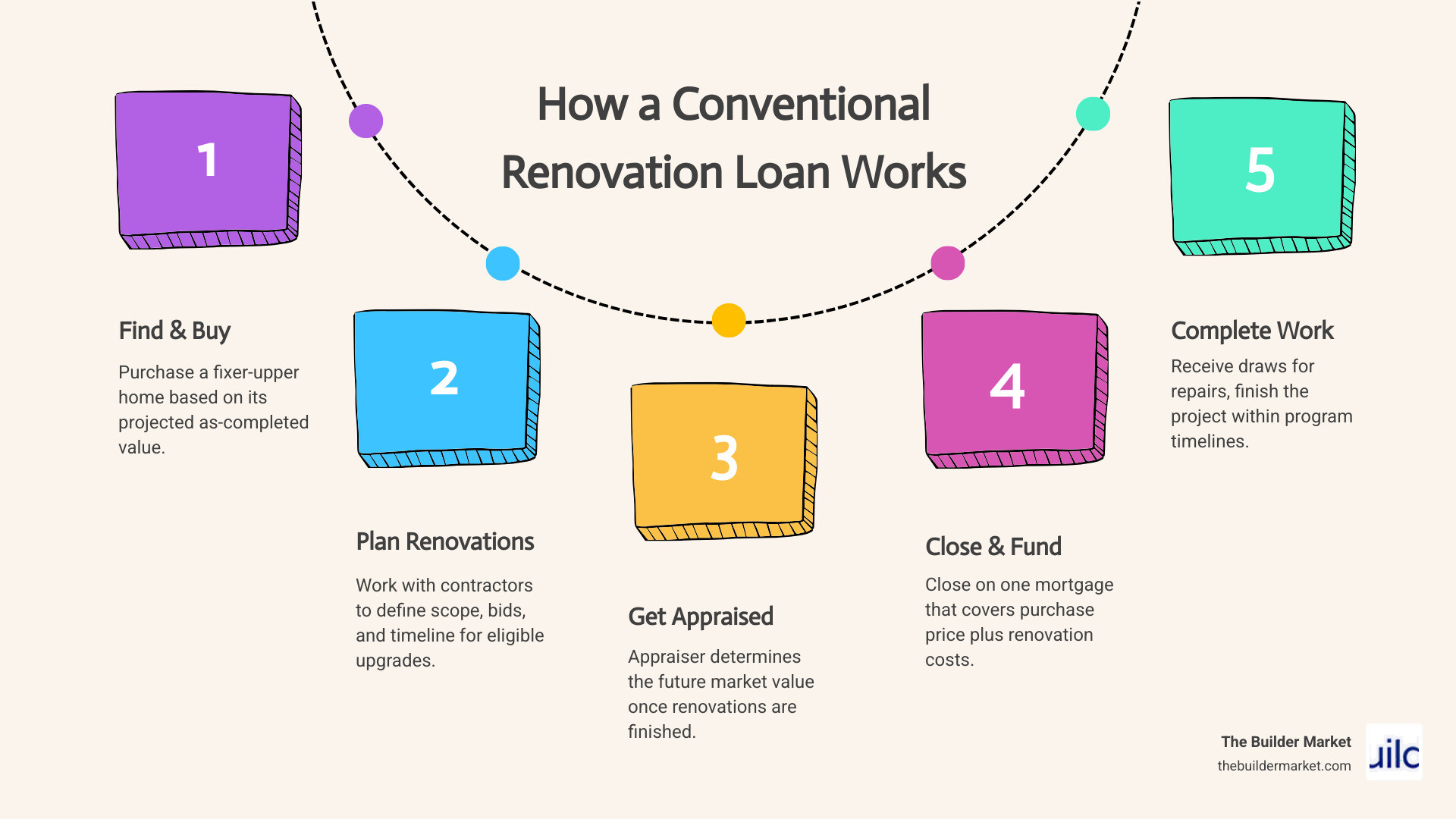
Steps to Close Your Conventional Loan for Fixer Upper Home
To ensure a smooth transaction, we recommend following these steps:
- Step 1: Get Pre-Approved: Work with a lender experienced in renovation financing to establish your total borrowing power (purchase price plus renovation budget).
- Step 2: Find Your Fixer-Upper: Work with a real estate agent who understands the unique requirements of distressed properties.
- Step 3: Select Your Contractors: Gather detailed bids from licensed and insured contractors. For flooring, carpet, and tile, hire a dedicated Flooring & Carpet specialist to ensure quality results.
- Step 4: Submit Plans to the Lender: Your lender will review the contractor bids, scope of work, and licensing details.
- Step 5: Order the Appraisal: The appraiser conducts the as-completed valuation.
- Step 6: Close and Begin Construction: Once closed, the purchase price is paid to the seller, and the renovation funds are placed into an escrow account. Your hired General Contractor can then begin the work.
- Step 7: Draw Disbursements and Final Inspection: As phases of the project are completed, the lender releases funds (draws) to the contractor after professional inspections verify the work was done correctly.
Conventional Renovation Loans vs. FHA 203(k)
When shopping for a fixer-upper mortgage, you will likely compare conventional renovation loans to the FHA 203(k) loan. While both serve a similar purpose, they differ significantly in cost, flexibility, and qualification requirements.
| Feature | Conventional Renovation (HomeStyle / CHOICERenovation) | FHA 203(k) (Standard & Limited) |
|---|---|---|
| Minimum Credit Score | 620 | 580 (with 3.5% down) |
| Down Payment | As low as 3% (first-time buyers) | 3.5% minimum |
| Property Types | Primary, second homes, investment properties | Owner-occupied primary residences only |
| Luxury Upgrades | Allowed (pools, outdoor kitchens, ADUs) | Prohibited (restricted to safety/cosmetic updates) |
| Mortgage Insurance | Private Mortgage Insurance (PMI) can be canceled at 20% equity | Mortgage Insurance Premium (MIP) usually lasts the life of the loan |
| Renovation Caps | Up to 75% of as-completed value | Limited is capped at $75,000; Standard has no cap |
Frequently Asked Questions about Fixer-Upper Financing
Can I use a conventional renovation loan for an investment property?
Yes! Unlike government-backed loans (FHA, VA, or USDA), which are strictly for owner-occupied primary residences, the Fannie Mae HomeStyle program can be used to finance one-unit investment properties. This makes it an excellent tool for real estate investors looking to purchase, rehab, and rent out single-family homes without relying on high-interest hard money loans.
What is the minimum credit score for a conventional renovation loan?
The standard minimum credit score required by conventional guidelines is 620. However, because renovation loans involve managing escrow accounts and construction timelines, individual lenders may enforce stricter underwriting overlays, sometimes requiring a score of 660 or 680 for approval.
Are luxury upgrades like swimming pools allowed?
Yes, conventional renovation loans allow for luxury upgrades, provided they are permanently affixed to the property and add to its overall value. This means you can use the loan to fund an in-ground pool, a detached garage, an outdoor kitchen, or a complete Kitchen Remodeling project with high-end appliances and custom cabinetry.
Conclusion
Buying a house that needs some extra love is an incredible way to build instant equity and customize a home to your exact preferences. Navigating a conventional loan for a fixer-upper home requires careful planning, but the payoff is a beautiful, updated home financed through a single, affordable monthly mortgage payment.
If you are planning a major structural change or a full-scale remodel, you will need a team of trusted, vetted professionals to bring your vision to life. At The Builder Market, our AI-powered matching system connects you directly with top-tier local contractors who specialize in everything from simple cosmetic updates to complete structural overhauls.
Ready to expand your home's footprint or build your dream space? Let us connect you with a specialist in Addition & Remodeling. Get started with professional addition and remodeling services today and take the first step toward making your fixer-upper project a resounding success!
Need Help?
Contact us today to discuss your needs. Our team is ready to help.
About the Author
The Builder Market
More Articles
View All PostsRelated Articles
Ready to grow with The Builder Market?
Explore listings, AI growth, sites, and lead options—or talk to our team about what fits your business.

