Services in The Ultimate Guide to Agile Planning Process, CA
Master the agile planning process with this ultimate guide covering levels, ceremonies, and scaling for better project outcomes.

Serving
The Ultimate Guide to Agile Planning Process, CA
What Is the Agile Planning Process (And Why It Matters)
The agile planning process is an iterative approach to managing projects that breaks work into short cycles, allowing teams to deliver value continuously while adapting to change at every step.
Here is a quick overview of how it works:
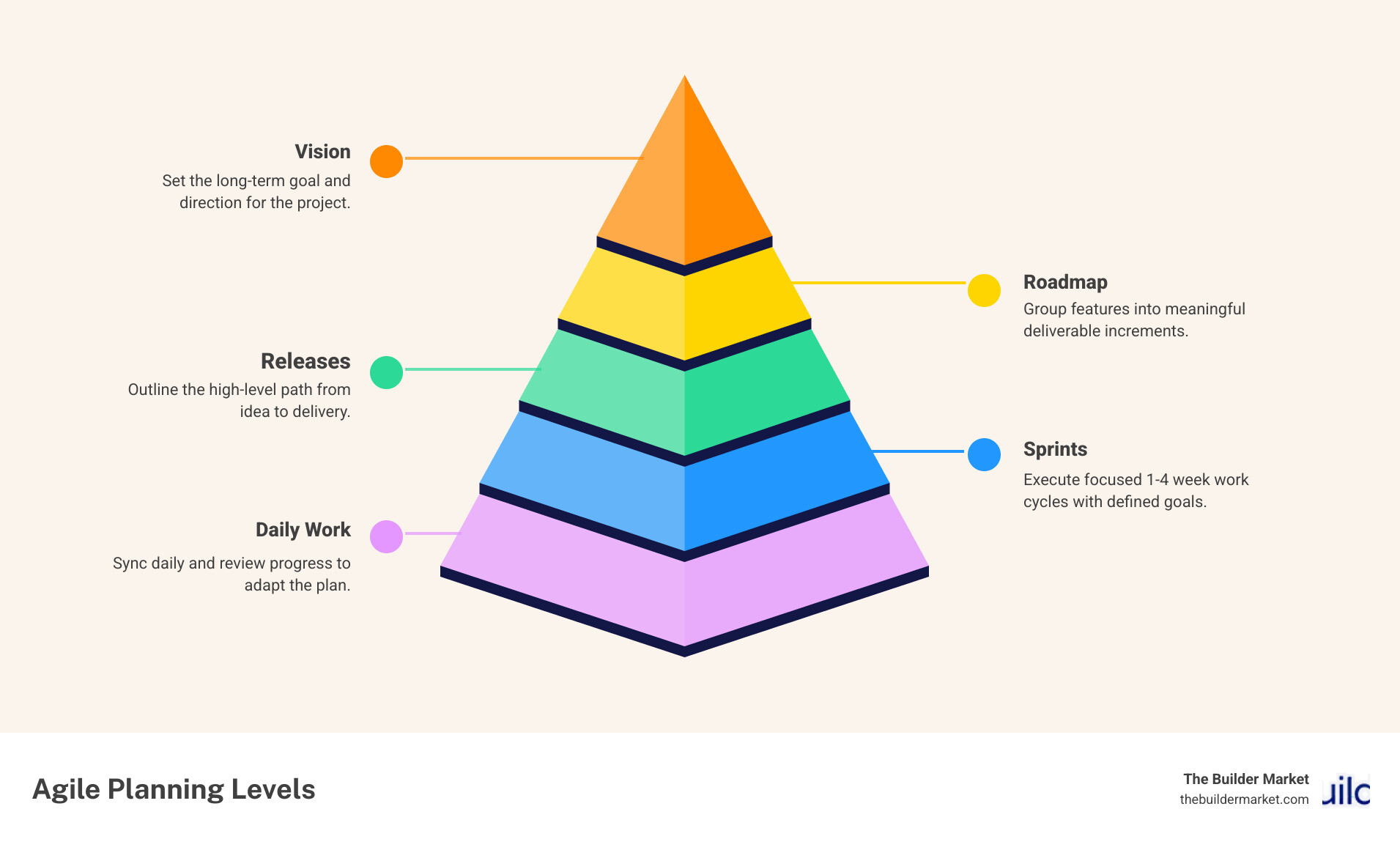
- Define a vision - Set a clear goal for what the project needs to achieve
- Build a roadmap - Outline the high-level path from idea to delivery
- Plan releases - Group features into meaningful, deliverable increments
- Run sprints - Execute focused 1-4 week work cycles with defined goals
- Hold daily standups - Sync the team on progress and blockers every day
- Review and adapt - Inspect results each sprint and adjust the plan accordingly
This cycle repeats continuously, keeping plans current and teams focused on what matters most.
Most project plans fail not because teams lack effort, but because the planning method itself assumes nothing will change. Requirements shift. Priorities evolve. New information surfaces mid-project. Rigid, upfront planning cannot absorb that reality.
That is exactly the problem agile was built to solve. Rather than locking down every detail at the start, agile planning works in layers — from a long-term vision down to what the team will do today. According to research from the Standish Group, the top two causes of IT project failure are incomplete requirements and lack of user involvement. Agile directly addresses both by keeping customers in the loop and treating requirements as something that evolves, not something that must be finalized before work begins.
The results speak for themselves. Studies show that 70% of agile projects are completed successfully, compared to 66% of traditional projects. And 95% of professionals affirm that agile is critically relevant to how their organizations operate today.
Whether you are managing a software build, a manufacturing improvement initiative, or a complex home renovation project, understanding how agile planning works gives you a real edge in delivering results on time and on target.
Relevant articles related to agile planning process:
- project management tools
- gantt chart application
- contractor scheduling software
Traditional Waterfall vs. the Agile Planning Process
To truly understand the agile planning process, we must first compare it to traditional waterfall project planning.
Traditional planning relies on "frontloaded cartography." We attempt to map out every single detail, task, dependency, and deadline before a single line of code is written or the first hammer is swung. This approach assumes we know the most about a project at its absolute beginning—which is almost never true.
From a triple constraint perspective (scope, time, and resources), traditional planning treats scope as fixed. If the scope is locked, then time and cost must expand to accommodate any unexpected hurdles.
Agile completely flips this equation. In an agile project, time and resources are typically fixed (or "time-boxed" into short sprints), while the scope remains flexible. We prioritize the most valuable features so that if we run out of time, we have still delivered the highest-impact results.
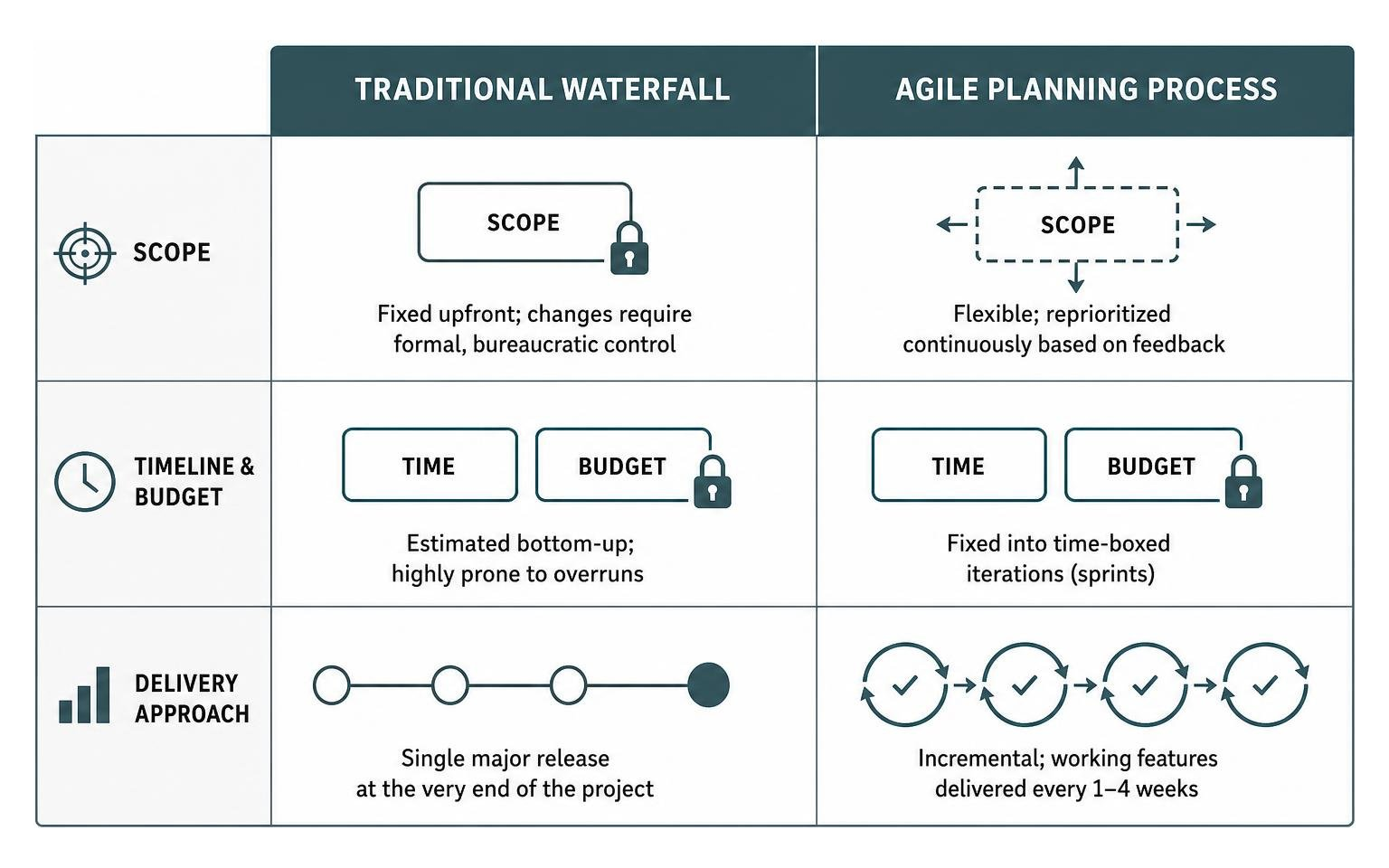
| Planning Characteristic | Traditional Waterfall Planning | Agile Planning Process |
|---|---|---|
| Scope | Fixed upfront; changes require formal, bureaucratic control | Flexible; reprioritized continuously based on feedback |
| Timeline & Budget | Estimated bottom-up; highly prone to overruns | Fixed into time-boxed iterations (sprints) |
| Delivery Approach | Single major release at the very end of the project | Incremental; working features delivered every 1-4 weeks |
| Customer Involvement | High at the beginning and end; minimal during execution | Continuous; feedback loop built into every iteration |
| Estimation Unit | Estimated in hours or days (often inaccurate) | Estimated in abstract story points or capacity metrics |
Managing Uncertainty and Changing Requirements
In any complex project, we face the "cone of uncertainty." At the beginning of a project, our knowledge is at its lowest, meaning our estimates have the widest margin of error. As work progresses, we learn more, and the cone narrows.
Traditional planning tries to force precision early in the cone when uncertainty is highest. This creates a customer mindset where stakeholders feel they must specify every single requirement upfront, fearing that any future changes will be too difficult or costly.
Agile planning embraces empirical control. We accept that we cannot predict the future. Instead of fighting change, we build short feedback loops into the schedule. By reviewing working increments at the end of every sprint, we gather real-world data and adjust our direction based on what actually works, rather than what we guessed would work six months ago.
The Five Levels of the Agile Planning Onion
We often describe agile planning as an onion because it consists of multiple overlapping layers of strategic alignment. We don't just plan once; we plan continuously at different time horizons.
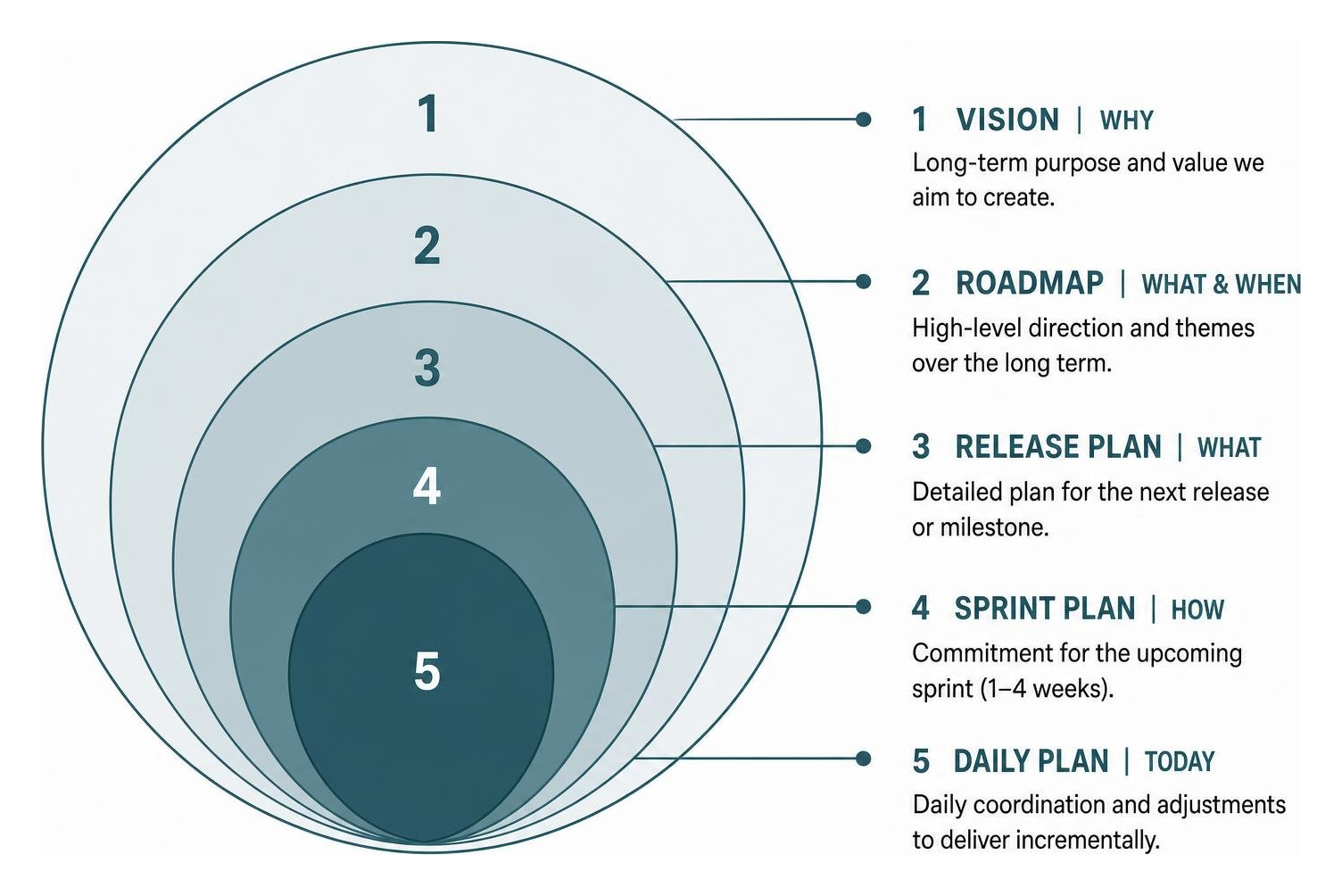
These layers ensure that what we do today directly supports our ultimate long-term objectives. While the outer layers focus on direction and strategy, the inner layers focus on execution and immediate delivery.
Connecting Vision, Roadmap, and Release Planning
Let's look at how the outer layers of the onion connect to keep our projects on track:
- Product Vision (6–12 months): This is our North Star. It answers the fundamental question: Why does this project exist, and who is it for? A great vision statement is simple and inspiring. For example: "For homeowners who want to modernize their living space, our platform is an intuitive marketplace that connects them with vetted professionals instantly."
- Product Roadmap (3–6 months): The roadmap translates our vision into high-level, theme-based milestones. Rather than listing specific features with rigid dates, we focus on outcomes and logical groupings of work.
- Release Planning (1–3 months): Also referred to as milestone planning, this layer groups valuable features into deliverable increments. While some teams release work continuously, milestone planning helps us align on when a satisfying, cohesive set of features will be ready for users.
Executing the Agile Planning Process at the Sprint and Daily Levels
Once we have our high-level direction, we zoom in to the execution layers:
- Sprint/Iteration Planning (1–4 weeks): At this level, the team commits to a small, manageable batch of work from the product backlog. We define a clear sprint goal and break user stories down into specific tasks.
- Daily Planning (15 minutes): Every day, the team meets for a brief standup. This is not a status report for management; it is a collaborative session where team members align on what they did yesterday, what they will focus on today, and any blockers standing in their way.
Key Ceremonies, Artifacts, and Tools in Agile Workflows
To keep the agile planning process moving smoothly, we rely on structured ceremonies, clear artifacts, and visual tools. These are designed to maximize transparency and foster continuous improvement.
In a standard Scrum framework, we organize our work around five core events:
- The Sprint: The time-boxed iteration where the work is performed.
- Sprint Planning: The meeting where we agree on the sprint goal and select backlog items.
- Daily Scrum: The daily 15-minute sync.
- Sprint Review: A collaborative session where we demonstrate working increments to stakeholders and gather feedback.
- Sprint Retrospective: A dedicated hour at the end of each sprint where the team reflects on what went well, what didn't, and how we can improve our processes in the next cycle.
Backlogs, User Stories, and Burndown Charts
Our progress is tracked through three primary artifacts:
- Product Backlog: A living, prioritized list of everything that might be needed in the product. It is managed and constantly refined by the Product Owner.
- User Stories: Instead of writing dry, technical requirements, we write requirements from the user's perspective. They follow a simple template: As a [user role], I want [goal] so that [reason]. This keeps the focus entirely on delivering customer value.
- Sprint Backlog: The specific subset of user stories selected for the current sprint, along with the team's plan for delivering them.
- Burndown Charts: A visual tool that shows the remaining work in the sprint on a daily basis, helping the team see at a glance if they are on track to meet their commitment.
Prioritization Frameworks and Information Radiators
We cannot do everything at once, which is why prioritization is the heartbeat of agile planning. We use several popular frameworks to organize our backlogs:
- MoSCoW Method: Categorizing items into Must-have, Should-have, Could-have, and Won't-have (for now).
- Value vs. Effort Matrix: Mapping features to identify "quick wins" (high value, low effort) and avoid "thankless tasks" (low value, high effort).
- Story Mapping: A visual technique where we lay out user stories along a horizontal axis (representing the user's journey) and a vertical axis (representing priority). This makes it easy to see how individual stories build toward a complete release or milestone.
To keep everyone aligned, we display these plans on "information radiators"—such as digital Kanban boards, task boards, and cumulative flow diagrams—making project status instantly transparent to anyone who walks by or logs in.
Story Points and Capacity-Driven Planning
One of the biggest shifts in agile planning is how we estimate work. Instead of trying to guess how many hours a task will take, we use story points.
Story points are an abstract unit of measure that accounts for three things:
- Complexity: How difficult is the work?
- Effort: How much physical or mental work is required?
- Uncertainty/Risk: How many unknowns are we dealing with?
To make estimation easier, we often use relative sizing (like the Fibonacci sequence: 1, 2, 3, 5, 8, 13) or T-shirt sizes (S, M, L, XL). The team estimates stories together, ensuring collective ownership of the plan.
When planning a sprint, we use capacity-driven planning. Instead of stuffing the sprint backlog with as much work as possible, we look at our actual team availability for the upcoming cycle (accounting for vacations, holidays, and meetings) and only commit to what we have the realistic capacity to deliver.
Using Velocity Ranges for Accurate Stakeholder Predictions
A team's velocity is the number of story points they successfully complete in a single sprint. While many managers make the mistake of using a single average velocity for long-term forecasting, we highly recommend using velocity ranges instead.
For example, imagine a team has completed nine sprints with an average velocity of 33 points. However, their actual delivery has fluctuated between 27 and 36 points per sprint.
If we need to predict what this team can deliver over the next five sprints, promising a single number based on the average (165 points) is risky. Instead, we present a range:
- Low-velocity prediction (27 points x 5): 135 story points
- High-velocity prediction (36 points x 5): 180 story points
By communicating our predictions as a range (135 to 180 points), we set realistic stakeholder expectations and leave room for the natural variability of complex project work.

Scaling Agile Planning and Applying It Beyond Software
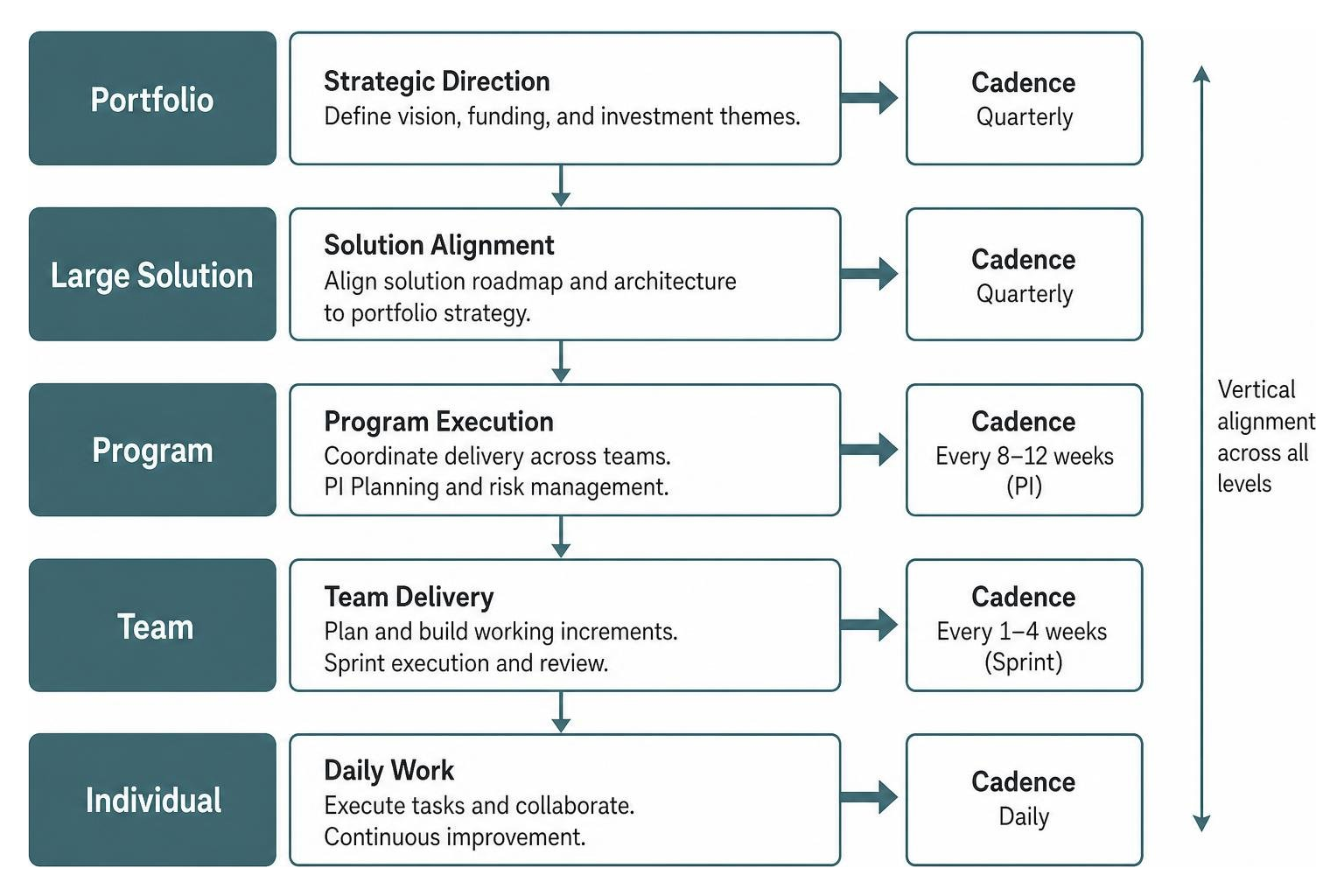
While agile planning started in the software industry, its benefits are so clear that organizations now scale these practices across massive enterprises and entirely different industries.
Enterprise Scaling with SAFe and LeSS
When you have dozens of teams working on a single, massive product, you need a structured way to keep everyone aligned. Frameworks like the Scaled Agile Framework (SAFe) and Large-Scale Scrum (LeSS) solve this challenge.
In SAFe, for example, teams align their planning cycles through a process called Program Increment (PI) Planning. Every 8 to 12 weeks, all teams within an "Agile Release Train" come together for a highly collaborative, two-day event to map out dependencies, identify risks, and align on shared strategic objectives. This ensures that while individual teams remain self-organizing, the entire enterprise moves in the same direction.
The Benefits of an Agile Planning Process in Construction and Manufacturing
Can agile planning work in physical industries like manufacturing and construction? Absolutely.
In manufacturing, continuous improvement teams use agile cycles to optimize complex plant operations. For example, a plant manager aiming to reduce machine changeover times (using SMED principles) might run two-week iterations to prototype, test, and document new procedures step-by-step, rather than trying to overhaul the entire factory floor in one massive, disruptive project.
In home planning and renovation, visual workflows mirror agile processes perfectly. Instead of spending months and thousands of dollars on architectural drafts before you even know what you want, we can use an iterative visual workflow:
- Site Plan (Sprint 1): Establish site boundaries and building orientation.
- Floor Plan (Sprint 2): Generate and compare three different layout strategies.
- Elevations & Facade (Sprint 3): Overlay style ideas and materials onto the layout.
- Landscape & 3D Visualization (Sprint 4): Review circulation, daylight, and overall flow.
By treating each stage as an iterative feedback loop, we can refine our home plans digitally before handing a validated design brief to a licensed professional for final certification. This reduces discovery time, minimizes expensive mid-construction change orders, and keeps budgets protected.
Frequently Asked Questions about Agile Planning
How often should an agile project plan be updated?
An agile project plan is a living document that should be updated whenever new information materially changes what is achievable. At a minimum, sprint plans are updated daily during standups and finalized at the end of each sprint. High-level roadmap and release plans are typically reviewed and revised monthly or quarterly during backlog refinement sessions.
What is the difference between milestone and release planning?
While the terms are sometimes used interchangeably, milestone planning focuses on achieving a specific business outcome or cohesive set of features (e.g., "enabling online checkout"). Release planning is the actual deployment of working software or deliverables to the end-user. Because modern teams often release work continuously, milestone planning is increasingly preferred to ensure that completed work adds up to a satisfying, logical whole.
How do you handle fixed deadlines in agile planning?
When faced with a fixed deadline, we must treat scope as our variable constraint. We work backward from the deadline, prioritizing the absolute highest-value user stories in our backlog. By using a "fixed-date, variable-scope" approach, we guarantee that when the deadline arrives, we will deliver a high-quality, working product containing the most critical features, rather than an incomplete mess of half-finished work.
Conclusion
Mastering the agile planning process is about shifting your mindset from rigid prediction to continuous adaptation. By breaking your projects down into manageable horizons—from a long-term vision to daily execution—you can manage uncertainty, align your team, and deliver real value consistently.
At The Builder Market, we bring this exact spirit of transparency, collaboration, and smart project management to the home improvement industry. Our AI-powered platform connects homeowners directly with vetted local professionals across the United States, helping you manage your residential projects with confidence and ease.
If you are planning a home renovation, custom build, or structural upgrade, having the right experts on your team is the first step to success. Connect with top-rated Litchfield Park architects and engineers today to start turning your vision into a buildable, beautiful reality.
Serving The Ultimate Guide to Agile Planning Process, CA
Contact us today to discuss your needs. Our team is ready to help.
Why Choose Us
- Local, Trusted Business
- Licensed & Insured
- Upfront Pricing
- 100% Satisfaction Guarantee
- Same-Day Service Available
Need Service in The Ultimate Guide to Agile Planning Process?
We've been proudly serving The Ultimate Guide to Agile Planning Process and the surrounding area. Contact us today for a free estimate.

