Step-by-Step Guide to Buying a Fixer Upper Loan
Learn how buying a fixer upper loan works with step-by-step guidance on FHA 203(k), HomeStyle, VA, and USDA renovation options to turn your dream home into reality.
Step-by-Step Guide to Buying a Fixer Upper Loan
Why Buying a Fixer Upper Loan Is the Smartest Move in Today's Housing Market
Buying a fixer upper loan is the key to unlocking homeownership in a market where move-in-ready homes are harder to find and more expensive than ever. In 2026, more buyers are turning to fixer-uppers as a practical path to building equity and getting into a home they can actually afford.
Here is a quick look at the main renovation loan options available right now:
| Loan Type | Min. Credit Score | Min. Down Payment | Best For |
|---|---|---|---|
| FHA 203(k) Standard | 580 | 3.5% | Major structural repairs |
| FHA 203(k) Limited | 580 | 3.5% | Non-structural repairs up to $75,000 |
| Fannie Mae HomeStyle | 680 | 3% (first-time buyers) | Conventional buyers, luxury upgrades |
| Freddie Mac CHOICERenovation | 620+ | 3-5% | Conventional alternative to HomeStyle |
| VA Renovation | Lender-specific (often 620+) | 0% | Eligible veterans and service members |
| USDA Rural Rehab | Lender-specific (often 620+) | 0% | Rural property buyers |
Fixer-upper homes are typically priced up to 50% less than comparable move-in-ready properties. That discount is real money — and when you pair it with the right renovation loan, you can finance both the purchase and the repairs in a single mortgage, based on what the home will be worth after the work is done, not what it looks like today.
That said, not every loan fits every buyer or property. The differences between programs — credit minimums, eligible repairs, timelines, and down payment requirements — matter a lot. This guide breaks them all down so you can compare your options clearly and move forward with confidence.
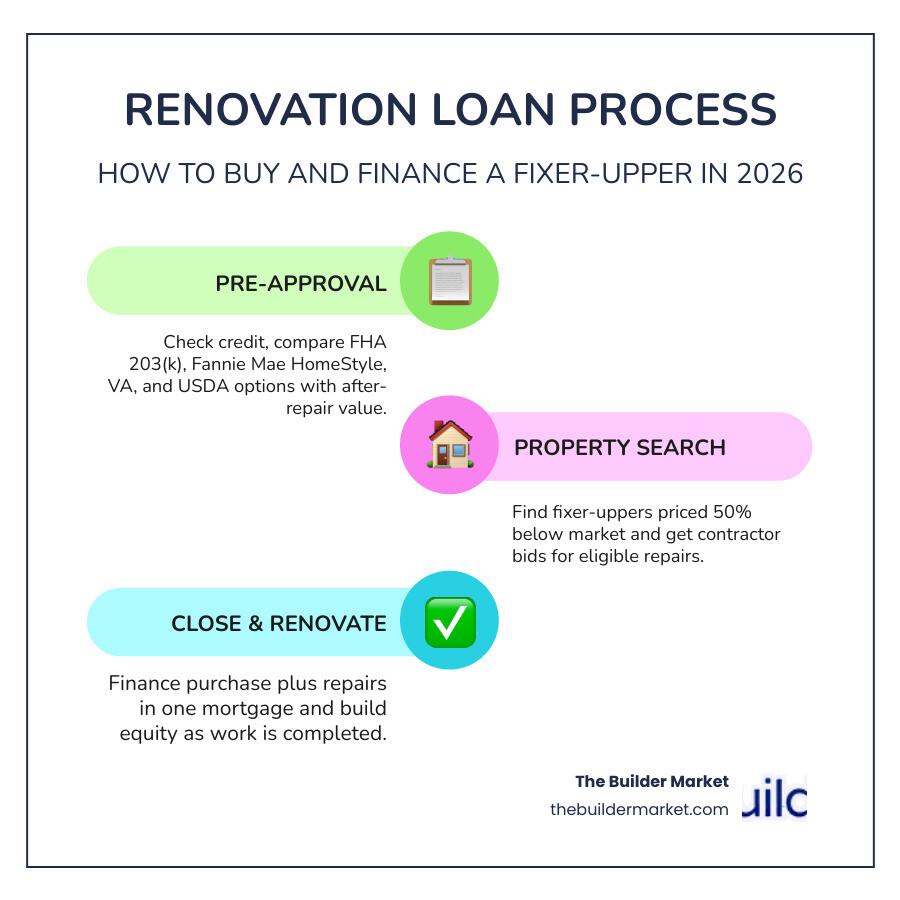
Buying a fixer upper loan terms explained:
- adding home improvement loan to mortgage
- best home improvement loans 2026
- construction loan for fixer upper
What is a Fixer-Upper and Why Choose One?
A fixer-upper is a property that needs repairs, updates, or a complete overhaul to reach its full potential. While some fixer-uppers only require cosmetic touch-ups like fresh paint and new flooring, others demand major structural work, such as foundation stabilization, roof replacements, or entirely new mechanical systems.
So, why would we choose a property that requires weeks or months of construction dust over a shiny, move-in-ready home?
- Bypassing Intense Market Competition: Turnkey homes often spark bidding wars, driving prices well over asking. Fixer-uppers tend to sit on the market longer, giving us more negotiating power and less pressure.
- Total Customization: Instead of paying for a previous owner's design choices, we get to select the layouts, materials, and finishes that match our personal style.
- Building Rapid Equity: Strategic renovations can generate $50,000 to $100,000 in equity within a single year. For instance, replacing a dated garage door can recoup up to 194% of its cost in added home value, while a minor kitchen remodel typically returns 70% to 80% of its initial cost.
- Lower Upfront Cost: Because these homes are priced up to 50% lower than their modernized neighbors, they present an affordable entry point into highly desirable neighborhoods.
However, taking on a project like this requires a cold, hard look at the home's true condition. This is why we always emphasize scheduling professional Home Inspections before finalizing any purchase. A general inspector will help us uncover what lies beneath the drywall, ensuring we do not accidentally purchase a structural nightmare.
Comparing Your Options for Buying a Fixer Upper Loan
When we set out to buy a distressed property, standard conventional loans usually fall short. Traditional underwriters require a home to meet strict "minimum property requirements" for habitability on day one. If a house has a leaking roof, a failed HVAC system, or missing kitchen appliances, a standard mortgage will likely be rejected.
This is where specialized renovation loans save the day. Instead of evaluating the home in its current distressed state, these loans underwrite the property based on its After-Repair Value (ARV). This means the lender appraises the home based on what it will be worth after all the planned improvements are completed.
By borrowing against this future value, we can roll the purchase price and the entire renovation budget into a single mortgage with one closing and one monthly payment.
FHA 203(k) Loans for Buying a Fixer Upper Loan
The Federal Housing Administration’s 203(k) program is one of the most accessible options for owner-occupants. It is designed to help buyers purchase a primary residence that needs immediate rehabilitation. The program is split into two distinct paths:
1. Limited 203(k)
- Best For: Minor, non-structural cosmetic updates.
- Renovation Cap: Up to $75,000 in total repair costs.
- Key Advantage: No minimum repair cost, and we do not have to hire an official HUD consultant. This streamlines the closing timeline, typically taking 35 to 55 days.
2. Standard 203(k)
- Best For: Major structural changes, additions, and extensive remodeling.
- Renovation Cap: No maximum renovation cost (subject only to county FHA loan limits).
- Key Requirement: Requires a minimum of $5,000 in repairs and the mandatory oversight of an FHA-approved 203(k) Consultant. The consultant conducts a feasibility study, drafts the official "Work Write-Up," and oversees contractor draw payments.
For both FHA 203(k) options, a minimum credit score of 580 is required to qualify for the low 3.5% down payment. If your score is between 500 and 579, you can still qualify by putting 10% down.
Eligible projects under the FHA 203(k) program include:
- Roof, gutter, and siding replacement
- HVAC, electrical, and plumbing system upgrades
- Kitchen and bathroom remodels
- Decks, patios, and basic landscaping
- Energy-efficient upgrades and solar installations
- Structural alterations and home additions
- Note: Luxury additions, such as new swimming pools or outdoor kitchens, are strictly prohibited.
Fannie Mae HomeStyle and Other Conventional Renovation Loans
If you have a stronger credit profile and want more flexibility with your design plans, conventional renovation loans are an excellent choice. The Fannie Mae HomeStyle loan is the gold standard of conventional rehab financing.
- Credit Score Minimum: Typically 680 (though some lenders may allow 620+ with compensating factors).
- Down Payment: As low as 3% for qualified first-time homebuyers, and 5% for repeat buyers.
- Renovation Cap: We can borrow up to 75% of the home's after-repair value (ARV) to cover renovation costs.
- Completion Timeline: Fannie Mae HomeStyle allows up to 10 to 12 months for project completion.
Unlike government-backed programs, the HomeStyle loan allows for luxury upgrades. If you want to install a swimming pool, build a detached guest suite (ADU), or construct an outdoor kitchen, this loan permits it as long as the features are permanently affixed to the property. Furthermore, HomeStyle loans can be used to finance second homes and single-unit investment properties, making them highly popular among real estate investors.
Freddie Mac’s CHOICERenovation and CHOICEReno eXPress serve as similar conventional alternatives, offering competitive terms and streamlined processes for smaller cosmetic updates.
VA and USDA Options for Buying a Fixer Upper Loan
For eligible military members and those looking to buy in rural areas, zero-down-payment renovation loans exist to make fixer-uppers incredibly affordable.
VA Renovation Loans
Designed for veterans, active-duty service members, and surviving spouses, VA rehab loans allow buyers to purchase and repair a home with 0% down. Lenders typically look for a credit score of 620 or higher. The repairs must focus on improving the safety, habitability, and energy efficiency of the property, and all work must be completed by VA-approved, licensed contractors.
USDA Rural Rehab Loans
For properties located in designated rural areas, the USDA offers a renovation option that also requires 0% down. These loans are intended to help low-to-moderate-income families buy homes that need rehabilitation. The repairs must focus on bringing the home up to basic structural and safety standards. Like the VA program, the home must serve as your primary residence.
The Step-by-Step Renovation Loan Process

Navigating a renovation loan involves more paperwork and moving pieces than a traditional mortgage. To keep your project on track, we follow a structured, step-by-step process:
- Get Pre-Approved: Before looking at homes, we meet with a renovation-certified lender to establish our maximum budget. Ensure your lender has direct experience with FHA 203(k) or HomeStyle loans, as these programs require specialized underwriting.
- Find the Property: Work with a real estate agent who understands fixer-uppers. That we need to factor the estimated repair costs into our overall purchase offer.
- Hire a Contractor & Get Bids: Once the home is under contract, we must immediately bring in licensed professionals. We will need a detailed, line-item bid breaking down materials, labor, and timelines. For help finding qualified, vetted builders, we can consult local experts in General Contracting and Remodeling.
- Order the "As-Completed" Appraisal: The lender will send an appraiser to review the home’s current condition alongside the contractor's written renovation plans. The appraiser will then calculate the projected after-repair value (ARV). Learn more about how this works by reviewing the rules surrounding Home Appraisals.
- Underwriting & Closing: The underwriter reviews our financial documents, the contractor's credentials, and the appraisal. Once approved, we close on the loan. The purchase funds go to the seller, and the renovation funds are placed into a secure escrow account.
- Complete the Work: Construction must begin within 30 days of closing. Funds are disbursed to the contractor in stages (draws) as milestones are met and verified by inspectors.
Vetting Contractors and Managing the Work
Because the lender's money is tied up in the future value of the property, they will not allow just anyone to do the work. You must use licensed, insured, and bonded general contractors.
Lenders require a clear draw schedule before construction begins. For example, the contractor might receive an initial draw for 50% of material costs at closing, followed by milestone payments after the framing, plumbing, and drywall pass inspection. A final 10% to 15% is typically held back until the final inspection is completed and the local municipality issues a Certificate of Occupancy.
While some programs (like Fannie Mae HomeStyle) offer a highly restricted "Do-It-Yourself" option, it is capped at 10% of the home's as-completed value, requires strict lender pre-approval, and only reimburses the cost of materials — not your personal labor. For any major structural, electrical, or plumbing work, professional certification is non-negotiable.
Pros, Cons, and Red Flags of Renovation Financing
Like any financial strategy, financing a fixer-upper comes with a unique set of trade-offs. Weighing these carefully helps us avoid common pitfalls.
The Pros:
- One Loan, One Payment: We avoid high-interest personal loans, credit cards, or second mortgages by rolling all costs into a single first mortgage with competitive interest rates.
- Instant Equity: Buying at a discount and renovating strategically often results in a home that is worth significantly more than our total investment on day one.
- Uninhabitable Properties Welcome: We can buy homes that would otherwise be rejected by traditional lenders, expanding our housing options.
- Mortgage Payment Escrow: If the home is unlivable during construction, many programs allow us to finance up to six months of mortgage payments (PITI) directly into the loan so we do not have to pay a mortgage and temporary rent simultaneously.
The Cons:
- Higher Upfront Costs & Fees: Renovation loans involve extra administrative fees, consultant fees, and specialized appraisal costs.
- Longer Closing Timelines: Expect closing to take 45 to 75 days, compared to 30 days for a standard mortgage.
- Strict Timelines: Most programs require work to begin within 30 days of closing and finish within 6 to 12 months.
- Mandatory Contingency Reserves: Lenders require us to budget an additional 15% to 20% contingency fund on top of contractor estimates to cover unexpected structural surprises.
Red Flags That Mean Walk Away:
While we love a good project, some homes are simply "money pits." We should seriously consider walking away if our inspections reveal:
- Severe Foundation Failures: Structural repairs can easily cost $25,000 to $45,000, quickly eating up our entire renovation budget.
- Extensive Toxic Materials: Widespread asbestos, lead paint, or toxic black mold can require specialized remediation that derails both our budget and timeline.
- Unpermitted Additions: Resolving past code violations with local building departments can result in costly fines and forced demolition.
- Over-Capitalization: If the total purchase price plus estimated renovation costs exceeds the market value of comparable homes in the neighborhood, the project does not make financial sense.
Frequently Asked Questions About Renovation Loans
Can I do the renovation work myself (DIY)?
In almost all cases, no. Most renovation loans require licensed, third-party contractors to perform the work. This ensures that the repairs are completed to professional standards, meet local building codes, and preserve the lender's collateral. Under programs like Fannie Mae HomeStyle, DIY is limited to minor, non-structural cosmetic updates, capped at 10% of the home's value, and will not pay you for your time or labor.
How is the loan amount determined for a fixer-upper?
The loan amount is based on the After-Repair Value (ARV) of the property. The lender’s appraiser reviews the home's current purchase price alongside the contractor’s detailed renovation plans and comparable sales of fully updated homes in the area. This allows us to borrow the purchase price plus the cost of renovations, up to the program's maximum loan-to-value (LTV) limits.
What happens if the renovation takes longer than expected?
Renovation loans have strict completion timelines — typically 6 months for FHA 203(k) Standard loans and up to 10 to 12 months for conventional options. If construction delays occur due to weather, permit backlogs, or material shortages, we must communicate with our lender immediately to request an official timeline extension. Unapproved delays can result in technical default or the freezing of remaining escrow funds.
Ready to Turn a Fixer-Upper Into Your Dream Home?
Buying a fixer upper loan is a powerful way to beat high housing prices, bypass market competition, and build substantial equity. However, transforming a distressed house into your perfect home requires the right team of professionals in your corner.
At The Builder Market, we make it simple to connect with vetted, local general contractors, remodelers, and specialists who understand the unique demands of renovation loan projects. Our AI-powered platform matches you with qualified pros in your area, giving you the tools, communication, and confidence you need to manage your remodel from start to finish.
Ready to take the next step on your renovation journey? Find trusted local remodeling professionals near you by exploring our Wasilla, AK Addition and Remodeling Guide and start building your home equity today!
Need Help?
Contact us today to discuss your needs. Our team is ready to help.
About the Author
The Builder Market
More Articles
View All PostsRelated Articles
Ready to grow with The Builder Market?
Explore listings, AI growth, sites, and lead options—or talk to our team about what fits your business.

